

Delhi Metro services were not curtailed across the network during the 10 October protest against the Chief Election Commissioner, the Delhi Metro Rail Corporation (DMRC) told the Supreme Court in an affidavit, while acknowledging restrictions at 45 stations and tendering an unconditional apology to the court.
The affidavit was filed in response to a contempt petition and was submitted on behalf of DMRC chairperson D. Thara, an IAS officer. The corporation said no train route was cancelled on the day, although entry and exit restrictions were imposed at selected stations following directions from law enforcement agencies.
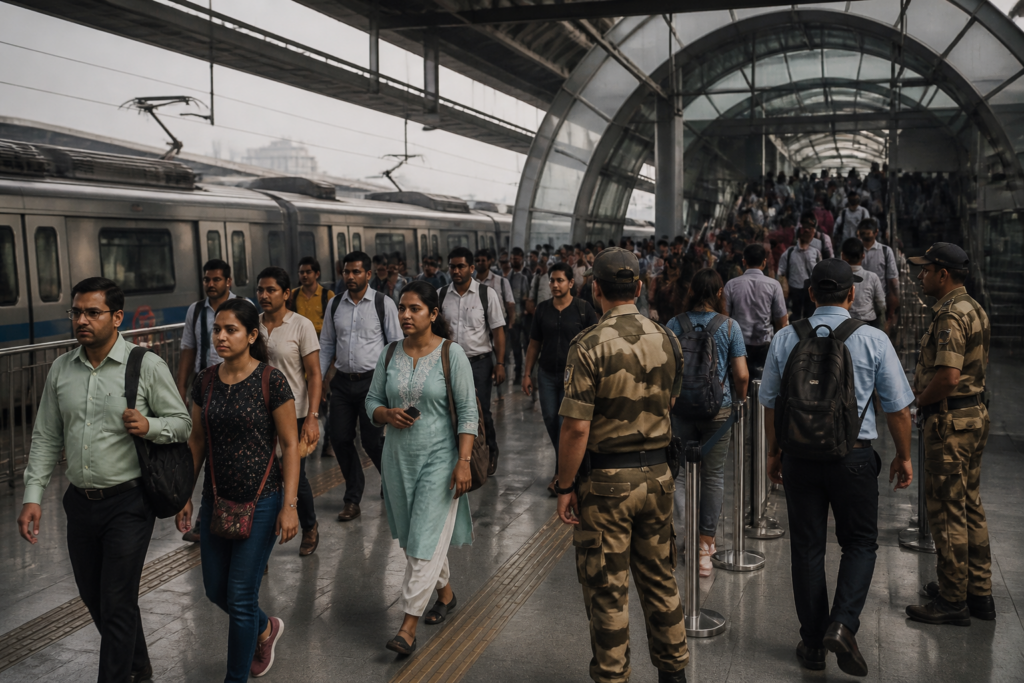
According to the filing, 258 of the Delhi Metro network’s 303 stations, or more than 85%, remained fully operational for passengers. Restrictions were imposed at 45 stations, representing about 15% of the network. DMRC said the measures were introduced in line with security assessments and instructions issued by law enforcement agencies.
The corporation also told the court that train operations were not reduced. A total of 271 trains operated on 10 October and completed 4,157 trips, which DMRC described as comparable to operations on an ordinary day. The figures were submitted to counter claims that essential public transport in the national capital had been completely shut down.
Passenger numbers, however, were substantially lower than usual. DMRC reported that around 3.2 million passengers travelled on the network on 10 October, compared with approximately 5.8 million passengers typically recorded on the second Saturday of a month. The corporation said the protest may have contributed to the decline, as many people could have chosen not to travel.
DMRC said restrictions were initially planned at 57 stations. After the Supreme Court intervened, the police reassessed the security requirements and reduced the number of stations subject to entry and exit restrictions to 45. The remaining restrictions were removed from 10 pm on 10 October, according to the affidavit.
The corporation also argued that directions issued on 9 October had been passed without hearing DMRC, as it was not present before the court at the time. DMRC alleged that the petitioners had given the court incorrect information by stating that essential public transport had been completely stopped.
The Supreme Court had earlier directed the Centre to ensure that there was no complete stoppage of metro operations or trains entering the national capital in view of the 10 October protest. A bench headed by Chief Justice of India Surya Kant also instructed DMRC and other parties to submit compliance affidavits. The latest filing was made in response to that direction and forms part of the court’s consideration of whether the operational restrictions complied with its order.


