

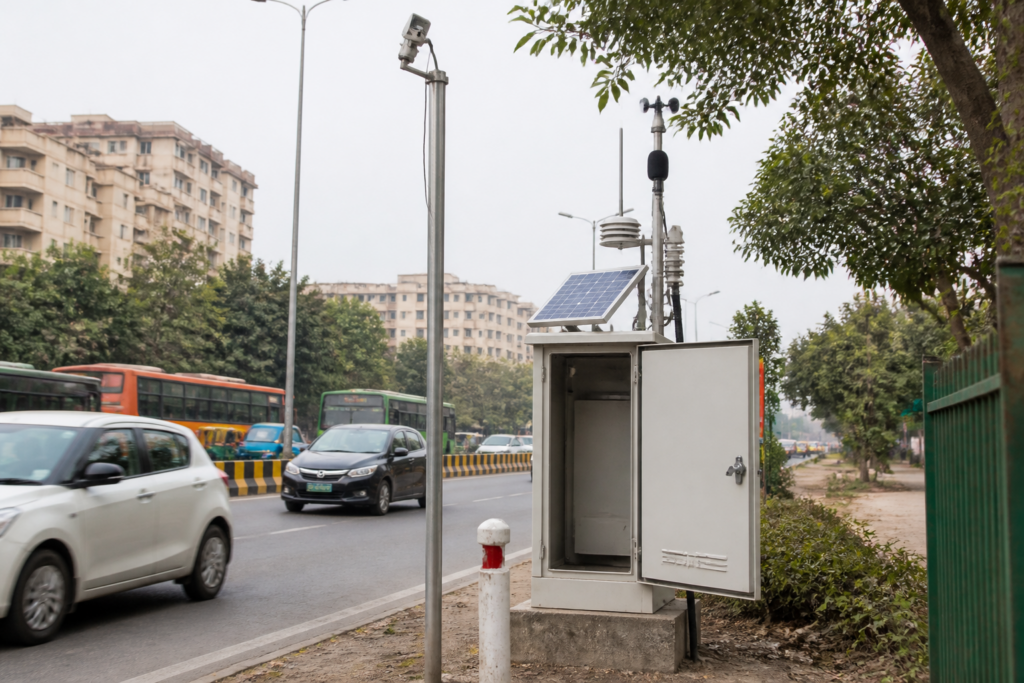
The Central Pollution Control Board (CPCB) has issued revised technical standards for real-time noise monitoring centres, paving the way for round-the-clock tracking of sound levels and automated alerts when prescribed limits are exceeded. The system is intended to help authorities identify where, when and for how long noise pollution crosses regulatory thresholds.
The revised standards have been issued to state pollution control boards and pollution control committees, which have been directed to procure and install monitoring centres accordingly. The first phase proposes four such centres. They will be connected to a central server and control room through 4G or 5G networks.
Under the proposed system, noise levels will be recorded every second. The equipment will be capable of measuring sound between 30 and 140 decibels. When the prescribed limit is breached, the relevant authorities will receive an SMS alert, allowing them to identify and respond to a location where excessive noise has been detected.
The monitoring data will be stored locally as a backup and retained on the central server for at least 10 years. This will allow authorities to compare noise levels across different days, months and years. The system is also designed to automatically generate daily, weekly, monthly, quarterly and annual reports.
A digital map will show the location and operational status of monitoring centres. When noise levels exceed the prescribed limit, the indicator for the relevant centre will change colour. The standards also provide for a portion of the data to be made available to the public through the websites of state pollution control boards, enabling residents to check noise conditions in their areas.
The centres may also be equipped with weather instruments, wind-speed sensors and devices to count vehicle movement, depending on local requirements. These additions are intended to help assess the role of traffic and weather conditions in rising noise levels. The proposed system includes solar power and battery backup so that monitoring can continue during electricity disruptions.
The CPCB’s revised standards follow a review by a committee of experts from the National Physical Laboratory, the National Environmental Engineering Research Institute, the Indian Institute of Technology Kanpur and the Central Road Research Institute in Delhi. The committee assessed the technical standards for the monitoring centres before the revised specifications were issued.
The standards also require equipment to be calibrated every six months to maintain measurement accuracy. Automated checks will be used to detect technical failures, while unauthorised opening or tampering with a monitoring centre cabinet will trigger an alert. The next stage will involve the procurement and installation of centres by the concerned state pollution control boards and committees under the revised technical framework.


