

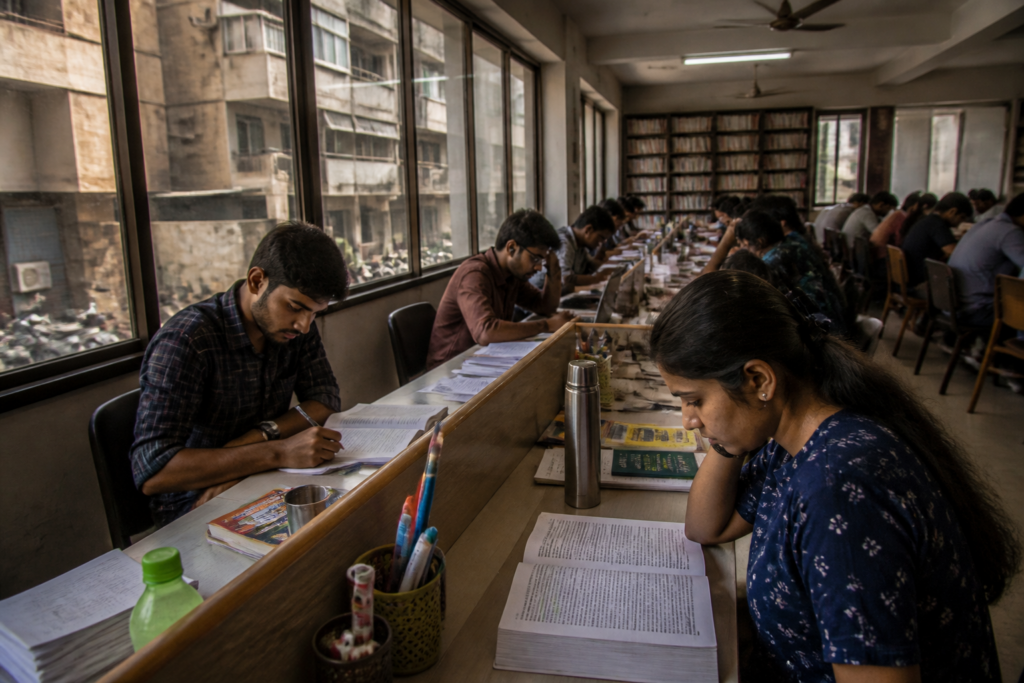
For MPSC aspirants in Pune, the examination is not confined to a question paper or a result date. It is a prolonged urban arrangement involving rent, study spaces, food, commuting, part-time work and family support. When recruitment cycles are delayed or examination patterns change, each uncertainty extends the cost of remaining in the city.
That burden is visible in Pune’s Narayan Peth and Karve Nagar, where study spaces known locally as libraries fill with candidates preparing for Maharashtra Public Service Commission examinations. The protests over alleged paper leaks and demands for the resignation of the MPSC chairperson have ended for now after the government decided to establish an investigative committee. But the concerns described by aspirants point to a larger problem: the cost of preparing for public employment is being transferred increasingly to candidates and their families.
The students’ accounts show that Pune functions as a preparation centre for aspirants from across Maharashtra. Ayodhya Umap, 22, has come from Chhatrapati Sambhajinagar. Preeti Nagawade, 24, is from Wade Bolhai, a village near Wagholi, while Atharva Pradhan, 24, is from Jaysingpur in Kolhapur. Their presence in the city depends on a fragile support system of hostels, paying guest accommodation, messes, libraries, family savings and, in some cases, employment alongside study.
This makes the city’s cost of living part of the examination system, even though it is not formally included in the commission’s timetable. Umap says hostel, paying guest and mess expenses keep rising. For candidates who can plan around an examination held on schedule, those expenses may remain manageable. Delays make them recurrent. A postponed examination does not only move a date on a calendar; it can require another month or year of accommodation, food, study space and preparation.
Pranita Kapse’s experience illustrates how these costs are absorbed at an individual level. The 24-year-old has prepared for civil services for two to three years and made two attempts. She cleared the Sarathi scholarship examination, but has also taken on several jobs to support her education and help her family. Her work has included coordinating a library for nine months, working at a drapery shop until 2 am, working in a business process outsourcing unit and tutoring older women in English.
The significance of this account is not that every aspirant faces the same circumstances. It is that preparation can become a multi-year period in which candidates must combine education, employment and household obligations. The examination is presented as a route into public service, but reaching the examination itself requires sustained private expenditure. For candidates from modest or rural backgrounds, the ability to remain in that process depends on resources that have little to do with academic performance.
Changes in the examination pattern add another layer of uncertainty. Kapse contrasts the MPSC system with the Union Public Service Commission process and says the state system lacks the accountability aspirants need. She also points to changes between objective and descriptive formats. Such changes affect not only what candidates study but also the value of the material, coaching and preparation strategies they have already invested in.
The problem is especially acute when candidates have limited access to study resources in Marathi. The students cited in the report say they often translate English and Hindi material themselves because quality Marathi-medium study material is difficult to find. This creates additional work before preparation can even begin. It also means that a candidate’s performance may depend partly on the ability to identify, translate and adapt material across languages, rather than solely on knowledge of the examination subject.
The language issue is closely connected to the geography of recruitment. Aspirants arrive in Pune from different parts of Maharashtra, bringing different levels of access to coaching, libraries, digital resources and family income. The city concentrates study spaces and preparation networks, but it does not remove inequality between candidates. Instead, those who can afford to stay longer and access better resources may be better placed to absorb delays and changes.
Umap’s account shows how examination uncertainty extends beyond finances. She describes the anxiety of not knowing whether the next examination will be transparent or whether it will be affected by a leak. Her concern is not limited to the possibility of losing a particular paper. If an examination is cancelled or repeated, candidates may lose an entire cycle of preparation, expenditure and personal planning.
That uncertainty also enters the home. Umap says neighbours ask how many more days the process will take, leaving her without an answer. For women aspirants, she says, families may add pressure related to age and marriage. The expectation that a woman must secure a post within a narrow age window can turn an administrative delay into a personal deadline. The result is a double burden: candidates must prepare for an uncertain examination while responding to questions about when the preparation will end.
Nagawade, who studied architecture and began preparing for MPSC during the final year of her degree in 2025, describes a different form of pressure. Her family, which runs a hotel and grocery store, supports her expenses in Pune. Yet living away from home and becoming emotionally detached from family are among the difficulties she identifies. She also speaks of the perceived need to secure a post by the age of 27, 28 or 29. The pressure is therefore not only about clearing a test; it is about demonstrating that years spent preparing have a defined endpoint.
The recruitment timeline cited by Pradhan shows why these concerns persist even after an examination is conducted. He recalls a batch that took the preliminary examination in 2023, the mains in November 2024, interviews in early 2025 and joined training only in May. According to his account, the batch spent almost three years in the examination cycle. The sequence illustrates the gap between holding an examination and completing recruitment. A candidate may clear one stage while remaining exposed to further waiting before appointment and training.
This is the institutional issue beneath the individual stories. Recruitment is experienced by candidates as a single promise: prepare, appear, qualify and join. Administratively, it is a chain of stages involving examinations, results, interviews, selections and training. Any delay at one stage lengthens the entire chain. If the process also faces allegations of paper leaks or requires an investigation committee, the uncertainty becomes more severe because candidates cannot easily distinguish a temporary delay from a disruption to the whole cycle.
The government’s decision to establish an investigative committee after the protests addresses the immediate allegations described in the report. It does not, by itself, resolve the wider questions raised by the aspirants: how examination calendars are protected, how changes in patterns are communicated, how Marathi-medium resources are supported and how long candidates should reasonably expect to remain in the system before recruitment is completed.
These questions matter because Pune’s preparation economy is built around waiting. Libraries provide desks, hostels and paying guest rooms provide accommodation, messes provide food and families provide money. None of these arrangements is guaranteed by the recruitment system, yet all become necessary when candidates must stay in the city for multiple attempts or extended cycles. The longer the process lasts, the more the burden moves away from the institution conducting the examination and towards the candidate maintaining a life around it.
The evidence in the reported accounts does not establish a single experience for all MPSC candidates, nor does it quantify the total cost of preparation in Pune. It does, however, show recurring pressures across different backgrounds: rising living expenses, uncertainty over examination schedules, changes in the pattern, limited Marathi-medium material, social expectations and recruitment timelines extending across years. The specific experiences differ, but they converge on the same institutional weakness: candidates cannot plan their lives around a process whose schedule and rules remain uncertain.
For Pune, the issue is also a reminder that the city’s role as an education and examination centre has consequences beyond classrooms and coaching spaces. Aspirants are temporary residents, workers, tenants and consumers while they prepare. Their ability to remain in the city is shaped by housing costs and informal support systems. When public recruitment becomes unpredictable, the urban burden is carried through private rooms, family budgets, part-time jobs and postponed decisions about work, marriage and relocation.
The investigative committee and the next examination decisions will determine the immediate direction of the controversy. But the larger question will remain whether the MPSC system can provide candidates with a recruitment cycle that is transparent, predictable and completed within a reasonable period. Until that happens, the price of uncertainty will continue to be paid not only in marks, but in years, rent, work and family pressure.


