

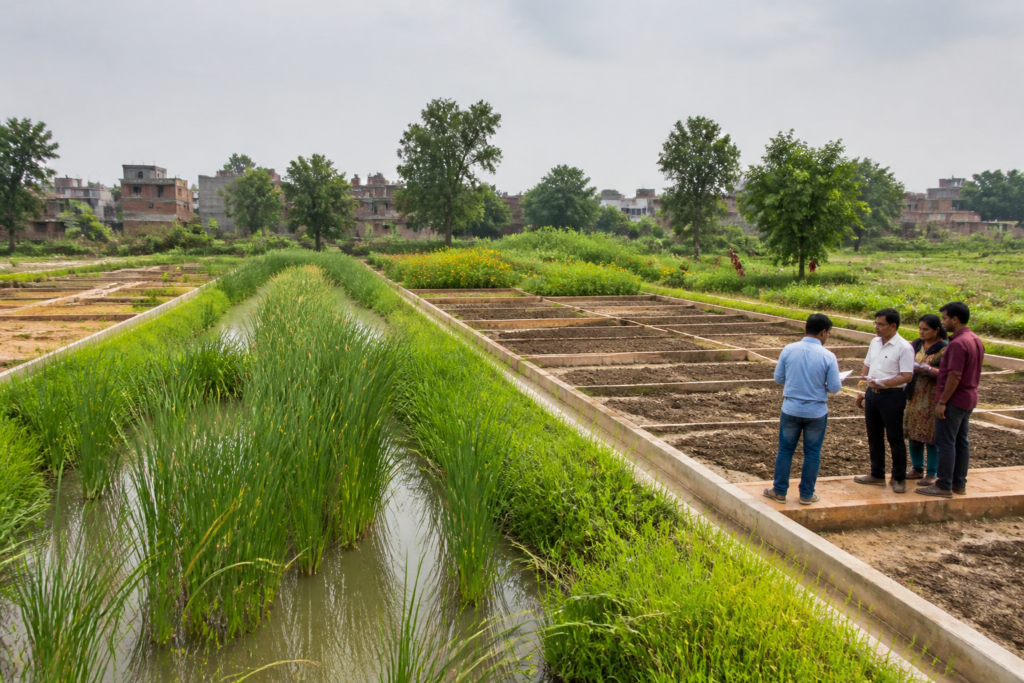
A CUSB researcher’s presentation of a nature-based faecal sludge treatment system at an international conference highlights a sanitation challenge that begins after a toilet is used: safely collecting, treating and disposing of the waste generated. The research, funded by the Anusandhan National Research Foundation, examines hybrid constructed wetlands combined with planted sludge drying beds as a decentralised alternative for places where centralised sewage infrastructure is limited.
Prashant, a teacher in the environmental science department at Central University of South Bihar, presented the work at the 19th IWA International Conference on “Wetland systems for water pollution control” in Chania, on Greece’s island of Crete. The conference brought together about 350 scientists, researchers, practitioners and policymakers from 55 countries to discuss sustainable approaches to water pollution control and wastewater management.
The immediate significance of the presentation is scientific. The larger urban question is administrative and infrastructural: sanitation systems cannot be judged only by the number of toilets built or households connected. They also depend on what happens to the waste once it leaves a toilet, septic tank or containment system. The Times of India report says the research focuses on an integrated treatment system that uses natural processes to manage faecal sludge while exploring the recovery of useful resources.
That distinction matters because toilet access and waste treatment are different parts of the sanitation chain. A sanitation programme can improve access to toilets without automatically creating the infrastructure, operating systems or treatment capacity needed to manage the resulting sludge. The report identifies scientific treatment and safe management of faecal sludge as critical to protecting public health and water resources, particularly where sewage networks and centralised treatment plants are not available.
The proposed system combines two components. Hybrid constructed wetlands use planted and engineered treatment zones to process wastewater or sludge through natural processes. Planted sludge drying beds are intended to reduce the moisture content of sludge while vegetation forms part of the treatment environment. In the CUSB research, the two are being studied as an integrated system rather than as isolated technologies.
The design points to a decentralised model. Instead of depending entirely on large, centralised treatment systems, smaller facilities could potentially serve rural and peri-urban settlements where conventional sewage infrastructure is limited. The report does not establish that the technology has already been deployed at scale or that it can replace conventional systems. Its significance at this stage lies in the research direction: developing a lower-energy, nature-based approach that could be adapted to locations outside large sewered cities.
The distinction between possibility and implementation is important. A technology presented at an international conference still requires evidence on performance, land requirements, operating conditions, maintenance, costs and the quality of treated outputs before it can be treated as a ready solution. The supplied report establishes that the research is being developed and demonstrated, but it does not provide field performance figures, construction costs, treatment capacity or details of an operating site.
This is also why faecal sludge management is not only a technology question. It involves the complete chain from containment and emptying to transport, treatment and final use or disposal. A treatment unit can function only if the wider system ensures that sludge reaches it safely and regularly. That requires clearly assigned institutional responsibilities, authorised service providers, monitoring and enforcement. The source report does not detail the local administrative model attached to the CUSB research, but its emphasis on decentralised treatment brings those governance requirements into view.
The public-health dimension is central. According to the report, CUSB researcher Prashant said untreated or inadequately treated faecal sludge can threaten local water bodies and undermine the gains made through sanitation programmes. The risk described is therefore not confined to individual households. Poorly managed sludge can connect sanitation failures to water pollution and the wider environmental health of settlements.
The water-resource connection also changes how sanitation infrastructure should be planned. A toilet is a point of access, while treatment is a system outcome. If waste is not contained, transported and treated properly, improvements at the household level can coexist with pollution risks elsewhere. The research’s focus on treatment and resource recovery places the final stages of sanitation inside the same planning conversation as water pollution control.
The circular sanitation element is another important feature of the proposal. The research explores whether treated outputs can be beneficially reused, shifting the framing of faecal sludge from a disposal burden to a potential resource. However, the available report does not specify which resources would be recovered, what quality standards would apply or where treated outputs could safely be used. Those details would determine whether resource recovery is a practical operating model or remains a research objective.
The work is described as aligning with the objectives of the Swachh Bharat Mission, particularly its emphasis on sustainable sanitation and scientific faecal sludge management. It also contributes to the United Nations Sustainable Development Goals, notably SDG 6 on clean water and sanitation and SDG 12 on responsible consumption and production. These connections place the research within an established policy vocabulary, but alignment with a policy objective is not the same as adoption within a municipal or rural sanitation programme.
For public agencies, the institutional challenge is to connect research, planning and operations. A decentralised system would need a site, land and an operator, along with a method for receiving sludge, recording inflows, maintaining planted treatment areas and checking the quality of treated material. The source does not state whether such an implementation framework has been finalised for this technology. That gap is significant because sanitation infrastructure often fails not only through a lack of construction, but through weak operation and maintenance after commissioning.
The conference itself provides a measure of the field’s breadth. Researchers, practitioners and policymakers from 55 countries attended, with around 350 participants examining wetland systems for water pollution control. The international setting indicates that nature-based treatment is part of a wider global discussion on sustainable wastewater management. It does not, by itself, establish that all such systems are suitable for Indian climatic, land-use or administrative conditions. Local demonstration and monitoring would remain essential.
The research is therefore best understood as a response to a structural mismatch. Sanitation access can expand faster than the systems required to manage waste safely. Centralised sewerage may not reach every rural or peri-urban settlement, while untreated or inadequately treated sludge can place pressure on water bodies. A decentralised, nature-based system could address part of that gap if it demonstrates reliable treatment and can be integrated into local service delivery.
What the report confirms is that CUSB research is examining hybrid constructed wetlands and planted sludge drying beds, with ANRF funding, as an integrated approach to faecal sludge treatment. It also confirms the research’s relevance to water pollution control, sustainable sanitation and resource recovery. What remains unestablished in the supplied material are the system’s measured performance, cost, scale of demonstration, land requirements and pathway to adoption.
Those are the next facts that will determine whether the proposal moves from an internationally presented research innovation to usable sanitation infrastructure. The central lesson is already clear: expanding toilet access does not complete the sanitation job. The waste generated must still be safely managed, treated and, where standards permit, recovered for beneficial use.


