

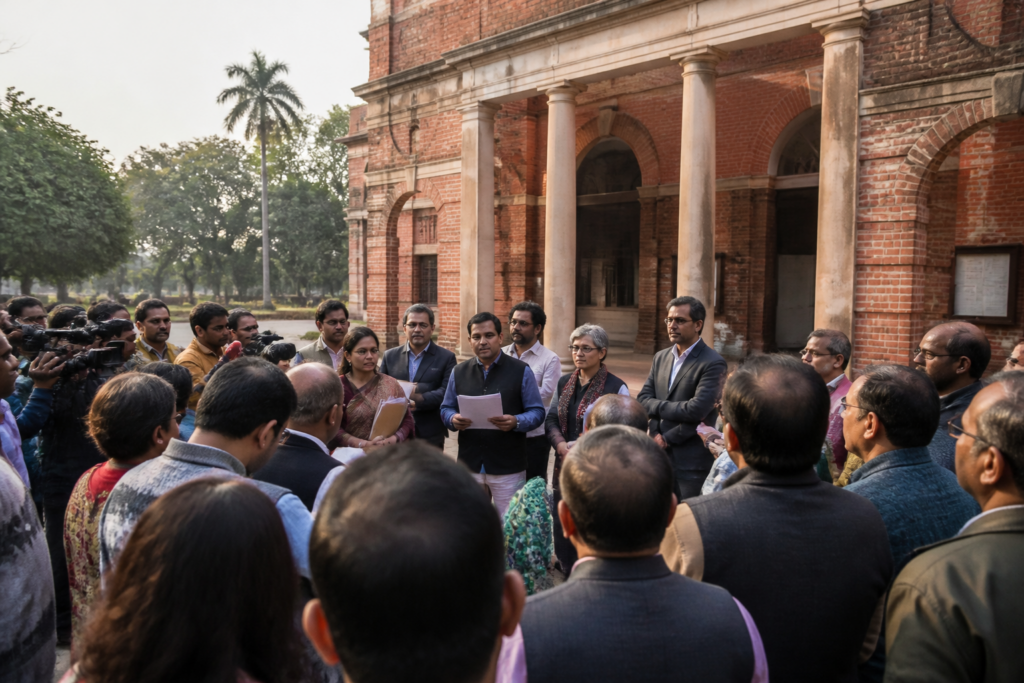
A 22-day protest at Delhi’s Hindu College has escalated, with the Hindu College Staff Association alleging irregularities in admissions, the bypassing of elected staff bodies and disciplinary action against faculty members. The administration has said admissions were handled centrally by Delhi University (DU), while officials have attributed excess supernumerary-seat allocation to a programming error in the university’s admission algorithm.
The allegations were raised at a media briefing at the college portico on Wednesday by members of the Hindu College Staff Association (HCSA). HCSA president Dr Ratan Lal accused the administration of violating the 20% cap on supernumerary seats for Sports and Extra-Curricular Activities admissions. The association also alleged that parallel committees had been created to weaken the role of elected institutional bodies.
Lal criticised the administration for issuing show-cause notices and taking disciplinary action against faculty members who had raised concerns. “You committed the wrong, and when we raised the issue, you claim it brought disrepute,” he said, adding that Hindu College was a public institution funded by taxpayers and open to public scrutiny.
Prof Chandrachur Singh, secretary of the Staff Council, alleged that administrative decisions had been taken without adequately involving the elected council. He described the Staff Council as a statutory body through which the college’s administration and academic governance operate under the university framework. Singh claimed that the council had been bypassed for years and that only around five meetings had been held in the past decade, with emergency meetings convened to approve urgent agendas.
The college administration has rejected the suggestion that its principal had direct discretion over the disputed admissions. Principal Anju Srivastava told The Indian Express that DU determines student eligibility, college allocation and subject preferences. Applications, she said, were processed through the Central Admission Committee and approved by the principal before students paid their fees.
According to officials, DU has attributed the excess allocation of supernumerary seats in popular courses to an inadvertent programming error in its central admission algorithm. The supplied report does not specify the number of seats affected or detail the corrective action taken by the university.
The protest has also raised concerns about caste and gender sensitivity on campus. Commerce professor Dr Poonam Saji said faculty members had heard issues shared by students that prompted questions about conditions at an institution ranked number one in the National Institutional Ranking Framework. Her comments formed part of the association’s broader criticism of the college’s internal accountability and administrative conduct.
HCSA members have additionally alleged growing corporate influence on campus, including the naming of buildings and staff rooms after corporate entities. Lal said the college was a public institution and opposed what he described as attempts to privatise it. The report does not establish whether such naming arrangements were formally approved or identify the entities involved.
The protest has received support from Rajya Sabha MP Prof Manoj Jha and Lok Sabha MP Sudhakar Singh, who visited the campus earlier this month. HCSA representatives also briefed members of the Parliamentary Committee on the Welfare of Scheduled Castes and Scheduled Tribes, including Faggan Singh Kulaste and P Wilson.
In a memorandum submitted to the DU Vice-Chancellor on October 1, the association sought a temporary takeover of the college by the university, an independent and time-bound inquiry into alleged administrative and financial irregularities, the removal of Governing Body chairman T C A Rangachari and Principal Anju Srivastava, and the unconditional withdrawal of disciplinary notices issued to faculty members. The report does not state whether DU has accepted these demands or announced a formal inquiry.


