

The Northeast Bankers’ Conclave 3.0 in Aizawl has put a rarely examined part of regional development under focus: whether improved connectivity can translate into better access to credit, markets and livelihoods for communities outside the Northeast’s main urban centres. Union minister Jyotiraditya M Scindia’s call for banks to expand into remote areas, alongside Mizoram chief minister Lalduhoma’s demand for higher lending and more corporate social responsibility funding, points to a development challenge that cannot be solved by transport infrastructure alone.
The issue is particularly relevant for Mizoram, where the state government has set banks a target of raising the credit-deposit ratio to at least 67% from 2028-29 onwards. The state’s credit-deposit ratio stood at 55.83% in 2025-26, according to the chief minister. Lalduhoma also said that seven banks operating in Mizoram had cash-deposit ratios below 40% as of June 2026. He noted that the state target remained below the Centre’s 70% benchmark, indicating a substantial gap between the deposits mobilised by banks and the credit being deployed locally.
This gap is not merely a banking-sector statistic. In remote and geographically difficult regions, the availability of formal finance affects whether farmers can expand production, whether small businesses can purchase equipment, and whether young people can start enterprises without depending on informal sources of money. At the conclave, Scindia asked banks to work more closely with farmers, entrepreneurs and local businesses, including helping producers reach wider and overseas markets.
The available figures also show that financial access is changing in another direction. Scindia said digital transactions accounted for 90.2% of transactions in the Northeast, compared with 81% nationally. The figure suggests that residents and businesses are adopting digital payment systems at a rate higher than the national comparison cited at the event. But digital transactions and access to credit are not the same thing. A person may be able to make a digital payment while still facing difficulty obtaining a business loan, crop finance or working capital from a nearby institution.
That distinction is important in a region where physical distance and terrain can shape access to public and private services. Digital payments can reduce the need to travel for routine transactions, but they do not eliminate the need for bank branches, customer support, documentation assistance, credit appraisal and local knowledge. The conclave’s focus on remote areas therefore reflects two parallel requirements: extending digital financial systems and ensuring that credit institutions remain connected to local economies.
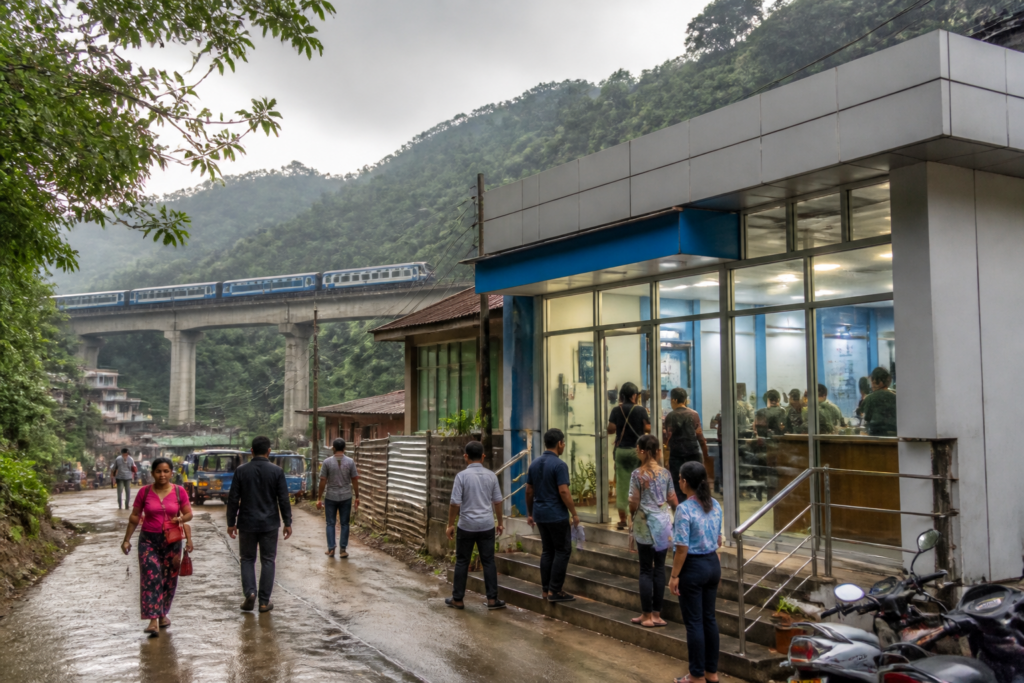
Mizoram’s development prospects are also being discussed alongside a major transport milestone. Scindia described the extension of railway services to Sairang as an important step for the state. He said the Bairabi-Sairang railway line would improve connectivity with the rest of the country, ease travel and support tourism. The railway connection could make movement more efficient, but the economic benefits will depend partly on whether local producers, tourism operators and small businesses can secure the finance required to use that connectivity.
Transport infrastructure changes the cost and reliability of movement. It can help goods reach markets and make destinations more accessible to visitors. However, infrastructure does not automatically create local enterprises or distribute economic gains evenly. Banks, state agencies and businesses must connect the transport network to production, storage, tourism services and market access. That is why the minister’s request for banks to help farmers market their produce is significant: it links financial services to the use of new and improved infrastructure rather than treating connectivity as an end in itself.
Tourism was another area highlighted at the conclave. Scindia referred to Mizoram’s near-100% literacy rate, forests, natural beauty and pleasant climate as strengths that could support tourism. Yet tourism-led development requires more than visitor potential. Small accommodation providers, transport operators, food businesses, guides and local producers need working capital and predictable access to finance. In remote areas, the absence of such support can limit the ability of local communities to participate in the tourism economy even when roads, railways or digital networks improve access to the destination.
The institutional question is who will coordinate this transition. The conclave was intended to strengthen cooperation between the government and banks and to ensure that people benefited from that partnership, according to Lalduhoma. His comments place banks within a wider community-development framework rather than viewing them only as financial intermediaries. The state government is seeking a stronger local lending response, while banks are being asked to reach remote communities and support farmers, young people and businesses.
Mizoram’s flagship Bana Kaih, or handholding scheme, has been linked with five banks to support farmers. Lalduhoma urged the participating banks to sustain their efforts and also called for loans for young people. The scheme’s involvement with multiple banks shows an attempt to use existing financial institutions to deliver state-supported economic assistance. The information supplied for the conclave does not establish the scheme’s total beneficiaries, lending volume or repayment performance, but its mention indicates that the state sees bank participation as central to livelihood support.
The chief minister also asked companies to direct more corporate social responsibility funding towards Mizoram, particularly to improve connectivity in remote areas. He argued that CSR spending had increased across the country but was not distributed evenly, and urged companies not to restrict funding to large, established projects. He also pointed to Mizoram’s strategic position as a link between India and neighbouring countries.
CSR funding cannot substitute for public infrastructure budgets or regular institutional finance. Its role, as described at the conclave, is supplementary: helping address gaps in connectivity and supporting projects that may not attract immediate commercial investment. The request also raises a question about the scale and continuity of such funding. The supplied report does not provide figures for CSR commitments to Mizoram or identify projects that have been approved, so the effect of the appeal will depend on what companies commit and how projects are selected and monitored.
The credit-deposit figures provide the clearest measure of the challenge currently identified by the state government. A ratio of 55.83% means that the lending level cited by the chief minister remains below the state’s proposed 67% target and the Centre’s 70% target. The seven banks with cash-deposit ratios below 40% indicate that the concern is not confined to a single institution. However, the figures alone do not explain why credit deployment is lower, whether demand is insufficient, or whether banks face difficulties in assessing risk, reaching borrowers or processing applications in remote areas.
That missing explanation is important for policy. Raising a ratio through targets may not be enough if farmers and small businesses lack collateral, reliable records, market access or technical support. Conversely, weak lending may reflect limited branch presence or insufficient outreach rather than a lack of viable local demand. The conclave brought these issues into the same discussion but did not establish which factor is most significant in Mizoram.
The contrast between digital transaction adoption and credit deployment makes the policy challenge more complex. The Northeast’s reported digital transaction share of 90.2% is higher than the national figure of 81%, but the state’s credit-deposit ratio remains below the targets cited by its leadership. This suggests that digital financial behaviour has advanced faster than the flow of formal credit into parts of the local economy. The figures should not be treated as proof of a direct causal relationship, but they do show that payment modernisation has not removed the broader financing challenge.
For urban and regional planning, the lesson is that connectivity must be understood as a system. Railways, banking services, digital infrastructure, tourism facilities and agricultural markets operate together. A new rail link can shorten travel time, but its impact on livelihoods depends on whether producers can finance expansion and reach buyers. Digital payments can improve transaction convenience, but they do not replace credit institutions. CSR can support remote projects, but it does not create a predictable substitute for public investment.
The Aizawl conclave therefore matters beyond the banking sector. It brings attention to the institutional links between infrastructure and economic participation in a geographically challenging region. Mizoram’s stated targets, the reported gaps in credit and cash-deposit ratios, the high share of digital transactions and the arrival of railway connectivity provide a measurable starting point. What remains unclear is how many remote communities are currently served, how much lending reaches farmers and young entrepreneurs, and whether new connectivity is producing local economic opportunities.
The next phase will depend on whether the commitments discussed in Aizawl translate into sustained bank outreach, higher local credit deployment, support for the Bana Kaih scheme and concrete CSR-backed connectivity projects. Those developments will determine whether improved access to transport and digital systems becomes wider economic access for Mizoram’s remote communities.


