

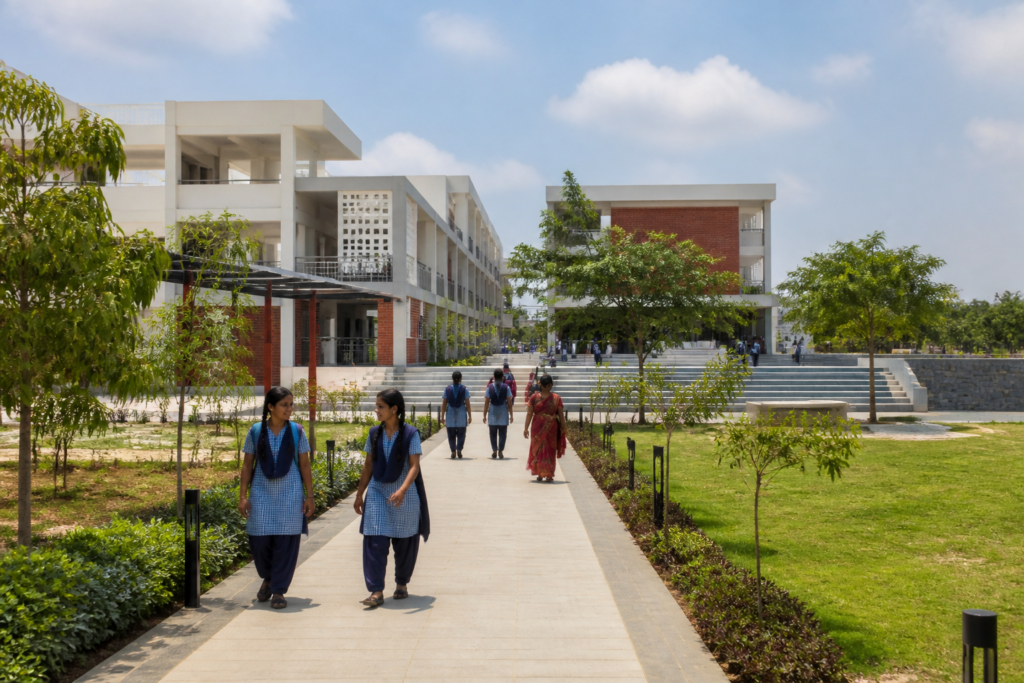
Telangana’s plan to invest Rs 24,000 crore in Young India Integrated Residential Schools is more than a large education announcement: it is a proposed expansion of the state’s public infrastructure network, with consequences for land, construction, staffing, residential capacity and access across urban and rural communities. The programme is expected to serve around 2.7 lakh students, while a parallel expansion of Telangana Public Schools is intended to create a wider state-run school system from the pre-primary level to Class 12.
The scale of the proposal was outlined by school education commissioner E Naveen Nicolas at a state-level workshop on school infrastructure organised by the planning and school education departments under NITI Aayog’s State Support Mission at Khairatabad. According to the report, each Young India Integrated Residential School campus is planned to accommodate 2,560 students from Classes 5 to 12. The campuses are intended to bring together facilities for Scheduled Caste, Scheduled Tribe, Backward Class and minority students, while also making provisions for children with special needs.
That design places the initiative within a broader question facing public education systems: whether new infrastructure can be planned as a network of complete institutions rather than as isolated buildings. The supplied details point to a multi-layered model involving residential campuses, public schools, integrated school complexes, classroom additions, digital systems, sanitation and nutrition. The programme’s eventual effect will therefore depend not only on the announced capital outlay, but also on how consistently these components are delivered and operated.
The proposed Young India campuses are one part of the state’s school infrastructure pipeline. Telangana plans 162 Telangana Public School campuses in 2026-27 at an estimated cost of Rs 1,141.15 crore. These schools are expected to provide education from pre-primary to Class 12. Officials also outlined a longer-term objective of establishing one Telangana Public School in each of the state’s 630 mandals. Taken together, those figures indicate an attempt to create a geographically distributed public school network rather than concentrate investment in a limited number of large campuses.
The two models serve different infrastructure purposes. The residential schools are designed around large, shared campuses for students from multiple social groups and include accommodation-linked facilities. The Telangana Public Schools, by contrast, are presented as local institutions covering the full school cycle. The distinction matters for planning because a residential campus requires capacity for living, food, sanitation and supervision in addition to classrooms, while a day school depends more directly on neighbourhood access and local connectivity. The report does not establish how sites will be selected, how construction will be sequenced or how operating costs will be distributed across the proposed network.
The state has also proposed Rs 7,004.92 crore in externally aided funding through the Asian Infrastructure Investment Bank. A further Rs 1,234.53 crore has been sanctioned for 16 integrated school complexes, upgrades to 17 institutions and 501 classrooms across 164 urban schools. These allocations show that the infrastructure programme is not limited to new campuses. It includes the expansion and upgrading of existing institutions, particularly in urban areas where demand can be absorbed through additional classrooms and improved facilities.
The combination of new construction and upgrades creates an administrative challenge. New campuses can be planned around a defined capacity, but existing schools must remain operational while additional classrooms and facilities are added. The reported figures also cover different funding stages: some amounts are described as planned, some as proposed and others as sanctioned. That distinction is important for assessing how much work is financially committed, how much remains dependent on approval and how quickly students can experience the promised improvements.
The report provides one indication of demand for upgraded public education. At the Arutla demonstration campus, enrolment reportedly increased from 744 to 1,585 students, a rise of 113 percent. The report said 72 percent of new admissions came from private schools. This figure is significant because it suggests that at least one demonstration institution attracted families who had previously chosen private education. It does not, by itself, establish that the same pattern will be repeated across the state, but it provides an example of how improved public-school facilities could influence enrolment choices.
The programme’s physical infrastructure agenda extends beyond classrooms. Digital infrastructure works worth Rs 666.75 crore were planned for 2023-26. The state has also allocated Rs 208.91 crore for 4,355 toilet units. These investments address two different but connected requirements: the ability of schools to support technology-enabled learning and the provision of basic services required for safe, usable campuses. For residential schools, such facilities are especially important because students are expected to spend substantially more time on campus than they would in a conventional day school.
Food and student welfare form another part of the proposed public-school system. Morning nutrition is reported to reach more than 20.59 lakh students through 39 central kitchens. Diet charges were raised by 40 percent, while cosmetic charges were increased by between 142 percent and 267 percent. The figures indicate that the state is treating recurring student-support services as part of school infrastructure and delivery, rather than limiting the programme to construction expenditure. However, the supplied material does not provide the revised per-student amounts or explain how the increases will affect the operating budgets of individual schools.
The state is also planning Young India Institutes of Excellence across 93 Kasturba Gandhi Balika Vidyalayas, with Rs 10 crore annually for preparation for the Joint Entrance Examination, the National Eligibility-cum-Entrance Test and the Common Law Admission Test. This links the physical expansion of public education to a more specialised academic support system. A Young India Police School has additionally been planned for children of police personnel, officials said at the meeting. The available details do not specify the locations, capacities or implementation schedules for either initiative.
The reported programme also includes 58,632 school improvement works valued at Rs 642.10 crore. Officials cited improvements of up to sevenfold in foundational literacy and numeracy. Because the source does not specify the baseline, measurement period or assessment method behind that claim, it cannot be used to compare performance across all schools. It does, however, show that the state is presenting infrastructure spending alongside learning outcomes, an approach that places pressure on the programme to demonstrate how buildings, classrooms, digital systems and student services translate into educational gains.
From an institutional perspective, the plan involves several layers of responsibility. The school education department is central to planning and implementation, while the planning department and NITI Aayog’s State Support Mission were involved in the workshop where the proposals were discussed. External financing through the Asian Infrastructure Investment Bank introduces another funding channel. The mix of state allocations, externally aided funding, sanctioned works and recurring service expenses means that the initiative will require coordination across capital planning, procurement, construction supervision and school administration.
The numbers also reveal the difference between physical capacity and public access. A campus designed for 2,560 students can create a substantial educational asset, but its practical reach depends on location, transport, admissions and residential arrangements. Similarly, one Telangana Public School in each of 630 mandals would create a broad geographic presence, but the supplied report does not state how many campuses already exist, how many new sites are required or when the full network could be completed. Those details will be necessary to judge whether the proposal represents a near-term construction programme or a longer-term institutional objective.
For urban areas, the planned upgrades to 164 schools and the addition of 501 classrooms are particularly relevant. Urban school systems must accommodate changing enrolment within constrained sites, often requiring construction to be integrated into already occupied campuses. The report does not provide city-wise allocations or identify which urban schools will receive the work. That information will determine whether the investment responds to the areas of greatest demand or is distributed according to a broader administrative formula.
The central urban question raised by Telangana’s announcement is how the state will convert a large, multi-component spending plan into functioning public institutions. The evidence supplied confirms the scale of the proposed investment, the intended student reach and the range of facilities under consideration. It also shows that the initiative is being developed alongside existing school upgrades, classroom expansion, digital works, sanitation, nutrition and academic support. What remains unclear are the project timelines, site-level distribution, operating arrangements and implementation status of the different components. Those will be the milestones to watch as Telangana moves from planning and sanctions to construction, admissions and measurable school performance.


