

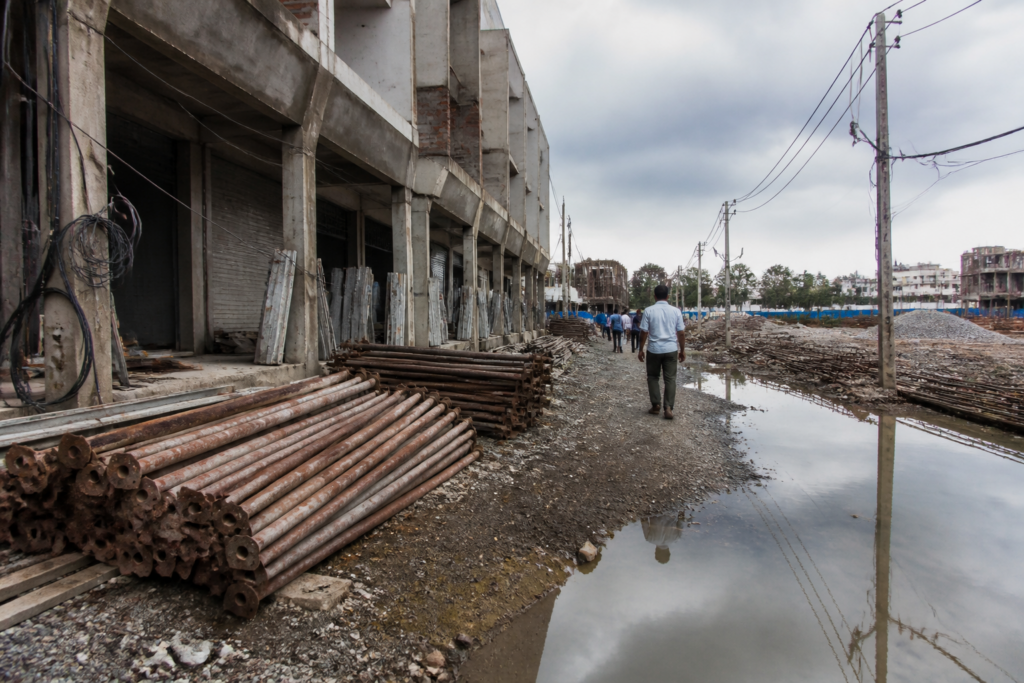
The death of a 16-year-old worker after he came into contact with an exposed electrical wire at a construction site in Ahmedabad’s Jagatpur area has brought the most basic question of site safety into focus: how was a minor allowed to work around unprotected electricity, standing water and heavy construction material without adequate safety equipment or supervision?
According to a report by Divya Bhaskar – Ahmedabad, Sachin Garasiya, who lived in Ghatlodia, was working at the Blue Well construction site near Jagatpur Char Rasta on October 11. He was there with his elder brother Mism Garasiya, who later filed the complaint. The report says Sachin was engaged in carrying iron supports at the site when he stepped on an exposed wire passing from an electrical switchboard. Water had accumulated nearby. He received an electric shock, fell and was taken to hospital, where he died during treatment.
Chandkheda police have registered a case against the site’s main contractor, Kanti Mistry, and supervisor Nanji Solanki. The complaint alleges that the two men allowed work to continue without safety equipment. These allegations remain part of the police case; the supplied report does not provide the accused persons’ responses or details of any further investigation.
The incident is significant not only because of the fatality but also because of the way the construction site appears to have combined several preventable hazards. An exposed electrical wire was reportedly lying in an area where workers were moving iron material. Water was also present. In such a setting, electrical safety was not an isolated technical issue. It was connected to the organisation of the worksite, the movement of labourers and the responsibility of supervisors to identify and control immediate risks.
The account provided by the complainant describes two brothers arriving together for daily wage work from the Kadiyanaka area of Ghatlodia. Mism was assigned plastering work for a shop, while Sachin was tasked with carrying iron supports to different parts of the site. That division of work matters because the fatal contact occurred while Sachin was moving material with another young worker. The danger was therefore located in an active work path rather than in an inaccessible or abandoned part of the premises.
The report does not establish how Sachin was recruited, whether his age was known to the contractor or supervisor, or whether any employment or identity records were checked. It also does not state whether the site had a designated safety officer, an electrical inspection process, protective footwear, barriers around wiring or a documented emergency response procedure. Those unanswered questions are central to understanding how responsibility was distributed at the site.
A construction project is governed in practice through layers of responsibility. The contractor organises labour and work activities. The supervisor directs workers on the ground and manages the sequence of tasks. Electrical connections, material handling and access routes must function together if workers are to move safely. In the reported case, the police complaint names the contractor and supervisor, indicating that the immediate focus is on the people responsible for operating and supervising the site.
That does not by itself establish the full chain of accountability. The supplied report does not identify the project owner, developer, electrical contractor or any agency responsible for approving or inspecting the premises. It also does not say whether the construction site had received prior warnings or whether any inspection had taken place. These details would be necessary to determine whether the incident resulted from a single lapse, weak supervision or a broader failure to maintain basic controls across the project.
The presence of a 16-year-old at the site creates a second institutional question. Sachin was a minor, but the report describes him as undertaking regular wage work alongside his brother. The source does not establish the circumstances under which he entered the site or whether the contractor knowingly engaged him. That limitation is important: the fact of his age is documented in the report, but the legal and administrative consequences of his employment would require the police and relevant authorities to establish the underlying facts.
The incident also exposes how a city’s construction activity can remain disconnected from the public systems that are expected to make worksites safe. Jagatpur is described in the report through a construction site, a nearby crossroads and workers travelling from Ghatlodia. The story is therefore not only about a private workplace. It involves the movement of labour across the city, the way small or localised construction activity is supervised, and whether safety responsibilities remain visible when work is carried out away from large, formally branded infrastructure projects.
The report contains no wider data on construction-site deaths, electrical accidents or the employment of minors in Ahmedabad. It would be inaccurate to use this single case to establish a citywide trend. What it does provide is a concrete sequence: a minor was assigned physical work; an electrical wire was reportedly exposed; water was present near the wire; the worker came into contact with it; he was hospitalised and died; and a complaint was registered against the contractor and supervisor.
That sequence is enough to identify the immediate evidence gap. The case will need to establish the condition of the electrical installation, the exact location of the wire, whether the water was connected to the electrical hazard, what safety equipment was available and who had control over the area. It will also need to clarify whether other workers were exposed to the same condition and whether the site was operating under any written safety arrangements.
The next layer concerns enforcement after the complaint. A police case can establish the criminal investigation, but the supplied report does not say whether the site was inspected, whether work was stopped, whether the electrical system was isolated or whether other government departments were informed. Nor does it state whether the family has received any assistance. These are not established outcomes and should not be assumed; they are the practical questions that determine whether the incident leads to accountability or remains limited to registration of a case.
For construction workers, safety is experienced at the point where they lift material, cross a work area or operate near temporary wiring. A contractor’s formal responsibility becomes meaningful only when it is reflected in those everyday conditions. In this case, the reported combination of an exposed wire, water and an active route for workers suggests that basic hazard control was either absent or ineffective. The police investigation will have to determine whether that condition was temporary, known or ignored.
The larger urban question is how construction can expand while the systems responsible for worker protection remain difficult to see. Buildings are produced through contractors, supervisors and daily wage workers, many of whom are not visible in project announcements or planning documents. When an accident occurs, accountability often becomes easier to name at the site level than to trace across the complete project structure. This case places that institutional chain under scrutiny without, on the evidence available, resolving it.
What is established so far is that Sachin Garasiya died after an electric shock at the Blue Well construction site in Jagatpur, and that Chandkheda police registered a complaint against contractor Kanti Mistry and supervisor Nanji Solanki. What remains to be established includes the precise safety condition of the site, the circumstances of the minor’s employment, the responses of the accused and the action taken by other authorities. Those findings will determine whether the case reveals an isolated failure or a deeper weakness in construction-site oversight in Ahmedabad.


