

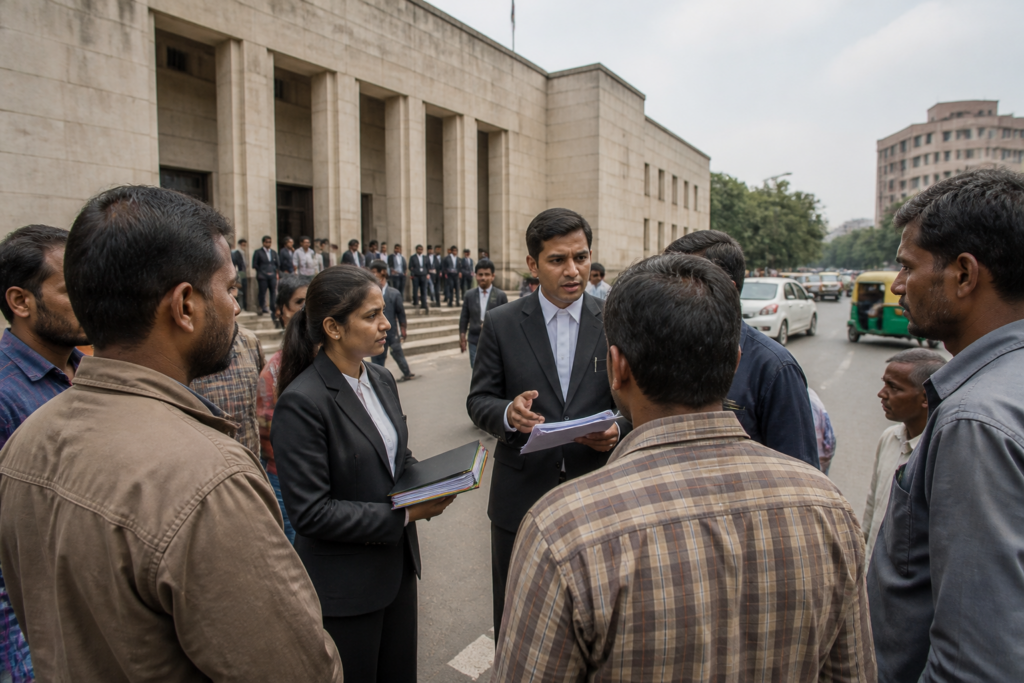
The Gujarat labour code protest has brought the functioning of labour and industrial courts to a halt, according to a report by Gujarat Samachar, after lawyers across the state began an indefinite strike against provisions they say transfer important judicial powers to administrative officers. The immediate disruption is being felt by workers whose cases are pending before labour institutions, but the dispute also raises a larger administrative question: can a department already operating with substantial vacancies absorb responsibilities previously handled by specialised courts?
The strike began after the four labour codes were officially implemented across the country on 21 November 2025, the report said. Gujarat has also finalised and brought its rules into operation. The codes listed in the report are the Code on Wages, the Code on Social Security, the Industrial Relations Code, and the Occupational Safety, Health and Working Conditions Code.
The lawyers’ objection is not limited to a change in legal terminology or procedure. Their central contention is that powers formerly exercised by labour and industrial courts have been assigned to administrative officers in the Labour Department. Under the earlier arrangement described in the report, labour courts had the authority to hear and conclude cases filed under various labour laws. The new provisions, the protesting lawyers claim, reduce that role and give administrative officials greater responsibility in handling such disputes.
That distinction matters because labour cases are not simply routine departmental files. They can involve wages, employment conditions, industrial disputes, worker protections and the continuation of livelihoods. The report says thousands of cases involving poor workers, daily wage earners and other employees have been affected by the stoppage of judicial work. It does not provide a case-by-case breakdown, a statewide pendency figure or an official estimate of the number of hearings delayed. The scale of disruption therefore remains reported rather than independently quantified in the supplied material.
The institutional concern raised by the lawyers is particularly focused on capacity. According to the report, the Gujarat Labour Department has significant vacancies, including at the levels of deputy labour commissioners and assistant labour commissioners. Officers are reportedly holding charge of more than one location, while some departmental work is being outsourced. The lawyers say the department is functioning at only 30 to 40 per cent of its sanctioned capacity.
That claim is central to understanding why the dispute has expanded beyond the question of jurisdiction. Even if the new labour codes require administrative officers to perform additional functions, implementation depends on the number of officials available, their territorial workload, the procedures they must follow and the systems in place to manage pending disputes. A transfer of responsibility on paper does not automatically create the personnel, training or time required to perform it effectively.
The report says the lawyers question whether officers carrying out administrative duties, and in some cases managing multiple locations, can also undertake work associated with adjudicating labour disputes. The concern is not presented as a finding by a court or an independent assessment of officer competence. It is the stated position of lawyers participating in the strike. That distinction is important because the available material does not include a response from the Gujarat government, the Labour Department, the judiciary or the authorities responsible for implementing the codes.
The dispute consequently contains two separate institutional questions. The first is about the design of the labour-code framework: which matters should be decided by courts, tribunals or administrative officers, and what right of appeal or review will be available to workers and employers? The second is about implementation capacity: whether the department receiving new responsibilities has adequate staff and operational resources to discharge them.
The supplied report does not set out the exact sections of the four codes that are being challenged. It also does not describe the formal legal status of the affected courts, the transition arrangements for pending cases or the precise mechanism through which existing matters are expected to move between judicial and administrative forums. Those details will determine how significant the change is in practice. Without them, the reported objections establish the nature of the dispute but not the final legal effect of every provision.
For workers, however, the immediate issue is practical rather than institutional. A labour dispute delayed by a strike remains unresolved, while a change in forum can create uncertainty about where a case should be filed, which authority will hear it and how long the process may take. Workers with limited financial resources are particularly dependent on accessible dispute-resolution systems. The report specifically identifies poor labourers, daily wage earners and workers as the groups whose rights and interests are at stake.
The interruption also exposes the dependence of the labour justice system on a chain of institutions rather than a single court. Lawyers, labour courts, industrial courts, departmental officers and government rules all form part of the process through which disputes are registered, heard and resolved. If one part of that chain is changed without sufficient staffing or clarity over responsibility, the result can be a backlog even before the merits of individual cases are considered.
The four-code framework was intended to consolidate existing labour legislation into a smaller number of codes. In Gujarat, according to the report, the state has finalised its rules following the national implementation. Consolidation can make a regulatory system easier to navigate only when the transition is clear and the institutions applying it are adequately equipped. The reported protest suggests that the transition has instead generated uncertainty among lawyers who regularly appear before labour and industrial courts.
The staffing information cited by the lawyers adds a second layer to the policy challenge. A department operating with vacancies may already have difficulty carrying out inspections, registrations, conciliation, compliance work and other administrative functions. If it is also expected to assume responsibilities connected with cases previously handled by specialised courts, the workload could become more difficult to manage. The supplied report does not provide sanctioned-strength figures, current staff rolls or budget data, so the 30 to 40 per cent capacity estimate cannot be independently tested from the available evidence.
The absence of those numbers is itself relevant to public accountability. A restructuring of labour adjudication affects workers, employers and the state, but its consequences cannot be assessed only through the language of legislation. The public also needs to know how many officials are available, how many cases are pending, how many matters will shift forums, what timelines will apply and what appeal mechanisms will protect parties who disagree with an administrative decision. None of those details is provided in the source report.
The strike’s indefinite character increases the importance of an official response. A short protest can delay hearings temporarily; an open-ended stoppage can interrupt filing, arguments, orders and case management across multiple institutions. The report says lawyers held demonstrations, sit-ins and slogan-shouting programmes on the first day of the action. It does not state whether the government has invited the lawyers for discussions, issued an order on court functioning or announced an interim arrangement for urgent labour matters.
The dispute therefore should not be read only as a confrontation between lawyers and the government. It is also a test of whether a major legal and administrative transition has been matched by institutional preparation. The stated objective of shifting responsibilities must be assessed alongside the capacity of the authority receiving them. If staffing, jurisdiction and procedure remain unclear, the formal implementation of a labour code may not translate into faster or more accessible dispute resolution.
What the available evidence confirms is that lawyers attached to Gujarat’s labour and industrial courts have begun an indefinite strike, citing the transfer of powers to administrative officers and severe vacancies in the Labour Department. What remains unclear is the precise legal operation of the new provisions, the number of cases affected, the department’s actual staffing position and the government’s response. Those are the developments that will determine whether the protest remains a professional objection or becomes a larger test of labour justice delivery in Gujarat.


