

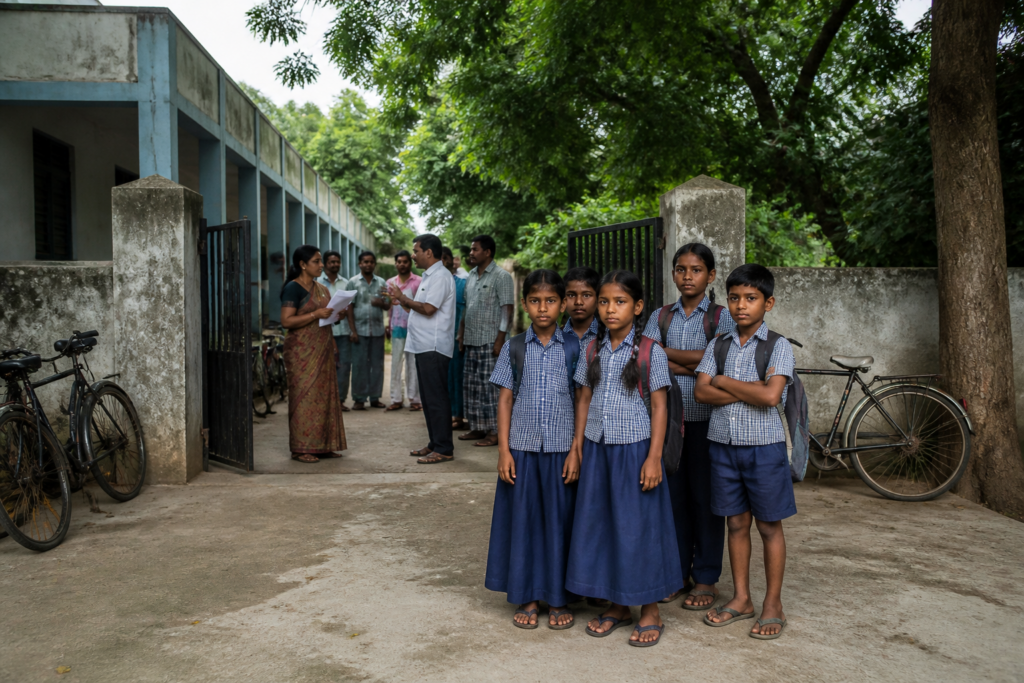
Tamil Nadu School Education Minister Rajmohan has ordered a detailed inquiry into allegations that students at a government school in Krishnagiri were made to stand outside after they did not pay Rs 350 collected through the parent-teacher association, while directing schools not to punish students or force families to make payments for events.
Speaking in Tamil Nadu, Rajmohan said teachers should not impose punishments on school students and that schools must not function as places of detention. His remarks followed complaints involving a school in Krishnagiri, where Rs 350 was reportedly collected from each student for activities organised through the parent-teacher association. Students who did not pay were allegedly made to stand outside the school.
The minister said no one should be compelled to pay money for school programmes and that students must not be punished for failing to make such payments. He also said that punishment should have no place in the School Education Department. The department has ordered a detailed investigation into the Krishnagiri allegations.
The episode places the operation of parent-teacher associations and school-level collections under scrutiny. The source report did not specify the name of the school, the total amount collected, the number of students affected or the proposed timeline for the inquiry. It also did not report a response from the school administration or the parent-teacher association.
Rajmohan separately warned private schools against dividing students into separate-examinee categories to secure a 100 per cent pass rate in public examinations. He said students who were not performing well should not be separated for this purpose. The minister also directed that special classes should not be conducted on Sundays or government holidays, warning that strict action would follow complaints.
The directions address several areas of school administration beyond physical or disciplinary punishment. They concern the treatment of students who cannot pay, the pressure created by examination performance targets and the use of holidays for additional classes. Together, they place responsibility on schools to ensure that administrative or academic practices do not result in unequal treatment of students.
The minister also reiterated that the Tamil Nadu government remained committed to its two-language policy. He said permission for new Central Board of Secondary Education schools would be granted only when the required documents were available.
On school management committees, Rajmohan said political party members would not be permitted to join and that only parents should be included. The statement links school-level oversight to parent participation rather than political representation, although the report did not provide further details on the composition, powers or functioning of the committees.
The immediate next step is the detailed inquiry into the Krishnagiri complaint. The School Education Department is also expected to act on complaints involving compulsory collections, student punishment, the separation of weaker students and special classes held on Sundays or government holidays.


