Telangana’s proposed Rs 24,000 crore investment in Young India Integrated Residential Schools is more than a plan to add school buildings. It is an attempt to redesign how the state delivers public education infrastructure, combining residential campuses, shared facilities for disadvantaged groups, digital systems, nutrition support and upgrades to existing schools. The scale of the proposal, however, makes implementation as important as the announcement itself.
The plans were outlined by school education commissioner E Naveen Nicolas at a state-level workshop on school infrastructure held in Khairatabad on October 14. The meeting was organised by the planning and school education departments under NITI Aayog’s State Support Mission. According to the report, the proposed Young India campuses would accommodate 2,560 students each, covering Classes 5 to 12, and the overall initiative is expected to benefit around 2.7 lakh students across Telangana.
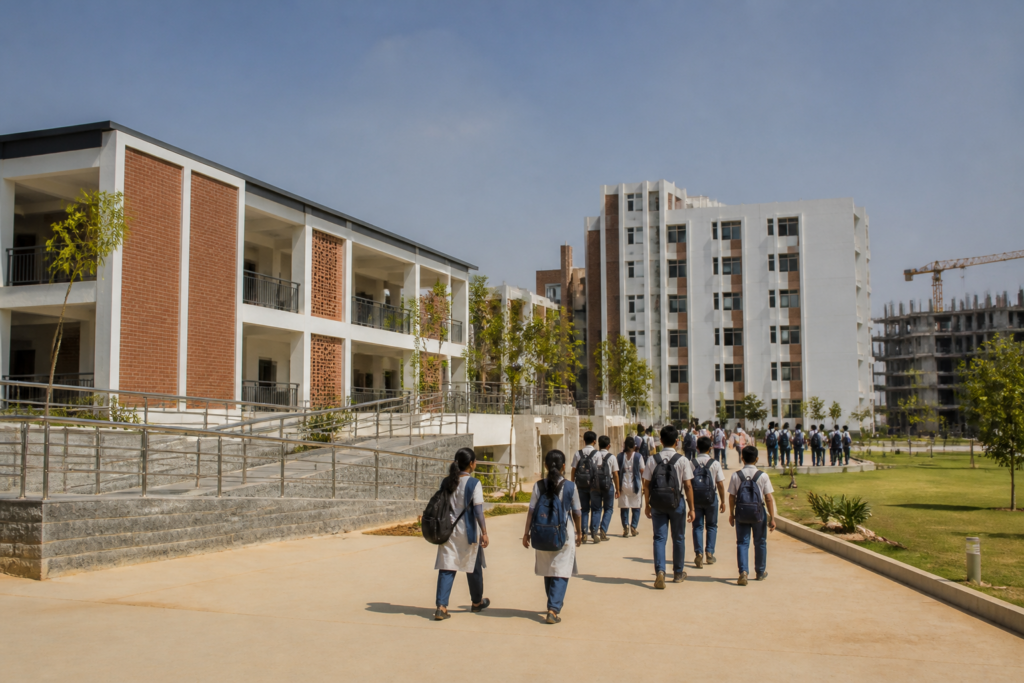
That design places the programme in the category of large public institutions rather than ordinary school expansion. A residential campus must provide not only classrooms but also accommodation, food, sanitation, healthcare-related support and facilities for students who may live away from their families. The plan also includes shared facilities for Scheduled Caste, Scheduled Tribe, Backward Class and minority students, as well as provisions for children with special needs. A separate Young India Police School has been planned for children of police personnel.
The stated model is therefore broader than increasing enrolment capacity. It seeks to bring multiple student groups into a common infrastructure framework while retaining targeted access. The supplied report does not establish how campuses will be distributed, how admissions will be decided, or how residential operations will be managed. Those details will be central to determining whether the capital investment translates into equitable access rather than simply a larger physical network.
The scale becomes clearer when the residential-school proposal is read alongside the state’s plans for Telangana Public Schools. Telangana plans to establish 162 public school campuses in 2026-27 at a proposed cost of Rs 1,141.15 crore. These institutions are expected to provide education from the pre-primary level through Class 12. Officials also described a longer-term vision of having one Telangana Public School in each of the state’s 630 mandals.
This creates two parallel infrastructure tracks. Young India Integrated Residential Schools are designed around large, residential campuses for Classes 5 to 12. Telangana Public Schools are planned as day-school campuses spanning the full school journey from pre-primary to Class 12. Both models address capacity, but they do so through different institutional arrangements. The report does not say whether the two networks will share land, staff, services or administrative systems.
The distinction matters because the success of a school infrastructure programme cannot be measured only by the number of campuses sanctioned. A campus has to be located where students can reach it, staffed for the grades and facilities promised, supplied with water and sanitation, and connected to the administrative systems that support attendance, meals and learning. For residential schools, the operational requirements are even wider because the institution also becomes a place of residence.
Funding is another significant part of the proposal. Telangana has proposed Rs 7,004.92 crore in externally aided funding through the Asian Infrastructure Investment Bank. The report also says Rs 1,234.53 crore has been sanctioned for 16 integrated school complexes, upgrades to 17 institutions and 501 classrooms across 164 urban schools. These figures suggest that the state is combining a large long-term investment proposal with separate allocations for existing campuses and urban-school improvements.
The funding mix also shows that the programme is not limited to greenfield construction. Alongside new residential and public-school campuses, the state is addressing older or existing institutions through integrated complexes, upgrades and additional classrooms. That is important for urban areas, where school infrastructure often has to expand within already developed neighbourhoods rather than on large, undeveloped sites. The supplied material does not provide details of the loan conditions, repayment structure, implementation agency or project timelines for the proposed external funding.
The state’s infrastructure plans also include digital systems and basic services. Digital infrastructure works worth Rs 666.75 crore were planned for 2023-26, while Rs 208.91 crore was allocated for 4,355 toilet units. These allocations place connectivity and sanitation within the same infrastructure conversation as buildings and classrooms. For schools, the physical quality of a campus is closely tied to whether essential services are available and maintained.
The report also cites 58,632 school improvement works valued at Rs 642.10 crore. The figure indicates a large volume of interventions spread across the school system, although the supplied material does not specify the types of work included or how completion has been assessed. Without that information, the number demonstrates the breadth of activity but not the condition or performance of the upgraded facilities.
Nutrition is another part of the state’s school infrastructure and service-delivery framework. Morning nutrition reaches more than 20.59 lakh students through 39 central kitchens. Diet charges were raised by 40%, while cosmetic charges increased by between 142% and 267%, according to the report. These measures show that the education system’s physical infrastructure is connected to recurring operating costs. Kitchens, toilets, classrooms and residential facilities require continuing expenditure after construction is complete.
The proposed residential schools will therefore create a substantial operating responsibility. The Rs 24,000 crore headline refers to the planned investment, but the report does not state the expected annual cost of staffing, food, maintenance, transport, utilities or student support. That distinction is crucial. A school campus can be completed as a capital project, but its public value depends on whether the state can sustain the services that make the campus functional over time.
The report offers one indication of demand for the new public-school model. Enrolment at the Arutla demonstration campus rose from 744 to 1,585 students, described as a 113% increase. It also says that 72% of new admissions came from private schools. The figures suggest that at least one demonstration campus attracted students who had previously been enrolled in private institutions. They do not, by themselves, establish whether the same pattern will be repeated across the proposed network or why families made that transition.
The state also plans Young India Institutes of Excellence across 93 Kasturba Gandhi Balika Vidyalayas, with Rs 10 crore annually for JEE, NEET and CLAT coaching. This extends the programme beyond basic access and infrastructure into preparation for competitive examinations. The announcement connects residential schooling with a pathway towards higher education and professional courses, although the report does not provide enrolment targets, staffing details or outcome measures for the coaching programme.
The emphasis on students from SC, ST, BC and minority communities, children with special needs, girls in KGBVs and children of police personnel gives the programme a defined inclusion dimension. But infrastructure alone cannot establish whether those groups will receive equal access or adequate support. That will depend on admission rules, campus design, staff capacity, accessibility standards and the way services are delivered. None of those operational details is specified in the supplied report.
The proposal also raises a question about administrative coordination. The workshop involved the planning and school education departments and was held under NITI Aayog’s State Support Mission. The funding references include state allocations and proposed external assistance, while the delivery plans cover residential schools, public schools, urban-school upgrades, digital infrastructure, sanitation, kitchens and coaching institutions. Such a broad programme will require coordination across budgeting, construction, education administration and daily operations.
The stated ambition of one Telangana Public School in each of 630 mandals illustrates the geographical scale of that coordination. The report gives the number of mandals and the proposed number of campuses, but it does not state how many schools already exist in those locations, which mandals will be prioritised or how land and construction schedules will be determined. It also does not clarify whether the 162 campuses proposed for 2026-27 represent the first phase of the 630-school vision.
The urban dimension is especially visible in the allocation for 501 classrooms across 164 urban schools and the plan for digital infrastructure. Urban schools may face different capacity and land constraints from large residential campuses. The report does not provide city-level locations or identify which urban schools will receive the classroom additions. As a result, the available evidence shows the scale of planned intervention but not its spatial distribution within Hyderabad or other urban areas.
What the announcement establishes is a broad public investment architecture: new residential campuses, a state-wide public-school network, upgrades to existing institutions, sanitation and digital works, centralised nutrition delivery and academic coaching. What remains unclear is the implementation sequence. The source does not specify construction deadlines for the Young India schools, the number of campuses to be built in each phase, the agencies responsible for delivery or the monitoring system that will track costs and outcomes.
Those unanswered questions do not diminish the size of the proposal; they define the next stage of scrutiny. For a programme of this scale, the important evidence will move from announcements to sanctioned projects, tenders, land parcels, construction progress, staffing, enrolment and operating budgets. The state’s own figures provide a baseline against which those milestones can eventually be assessed.
Telangana’s school infrastructure push is therefore significant both for its financial scale and for the range of public services it seeks to combine. The immediate announcement confirms an ambitious expansion of residential and public schooling, supported by allocations for classrooms, sanitation, digital systems, nutrition and coaching. The central implementation question remains whether the state can convert this wide-ranging capital plan into campuses that are accessible, adequately staffed and sustainably operated across the state.