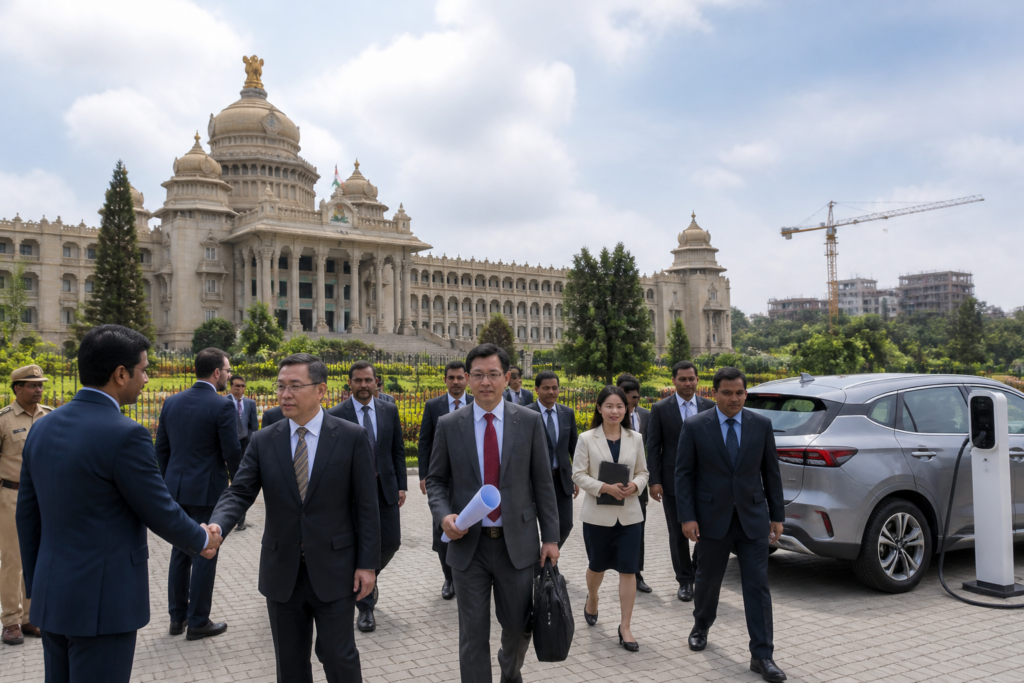
Karnataka’s effort to attract Czech investment beyond Bengaluru is significant because it shifts the conversation from securing more capital for the state to deciding where that capital should be located. At a meeting with a Czech delegation at Vidhana Soudha, Deputy Chief Minister and Industry and Trade Minister Karel Havlicek, Chief Minister DK Shivakumar urged companies to consider districts across Karnataka rather than limit their presence to the state capital. The proposal brings together two persistent urban and economic challenges: Bengaluru’s concentration of jobs and investment, and the difficulty of creating credible industrial alternatives elsewhere.
According to a statement issued by Shivakumar’s office, the Czech delegation’s visit to India from October 11 to 16, including Bengaluru, is intended to identify investment opportunities and strengthen business cooperation. The meeting therefore remains at the stage of investment outreach rather than confirmed project execution. Shivakumar identified energy, automobile components, future mobility, aerospace and defence as possible areas of cooperation. He also invited Czech energy major EPH, which he said has no presence in India, to explore opportunities in Karnataka.
That distinction between an investment invitation and a committed project is central to understanding the announcement. The state has articulated sectors, named potential corporate partners and outlined facilitation channels, but the supplied information does not confirm final investment amounts, locations, land allotments, project timelines or employment commitments. The next test will be whether the visit produces proposals that can move through feasibility, approvals, financing and implementation.
The geographic objective is nevertheless clear. Bengaluru has become Karnataka’s dominant platform for technology, aerospace, advanced manufacturing, research and high-value employment. That concentration creates advantages for companies because suppliers, skilled workers, universities, investors and public institutions are already clustered around the city. It also makes decentralisation difficult. Asking companies to locate in other districts is not only a matter of offering land or incentives; it requires a wider ecosystem capable of supporting production, research, logistics, workers and everyday urban life.
Shivakumar’s appeal referred to Karnataka’s strengths in agriculture, forestry, horticulture and floriculture, alongside its industrial and technology base. These sectors do not automatically translate into geographically distributed manufacturing. They require different infrastructure, supply chains, technical skills and market connections. A district seeking automobile-component or energy investment may need industrial land, dependable power, transport links, testing facilities, water systems and institutions that can process approvals without creating delays. For aerospace, defence and future mobility, the requirements also include precision manufacturing capabilities, specialised suppliers, research partnerships and a workforce trained for complex production.
The state government said investments would be facilitated through Invest Karnataka, Karnataka Udyog Mitra, the Karnataka Industrial Areas Development Board and the single-window clearance system. These institutions are important because the location of investment is shaped not only by corporate interest but also by the predictability of public administration. A single-window system can reduce procedural friction, but it cannot by itself resolve gaps in regional infrastructure or the absence of local suppliers and skills. The effectiveness of the proposed decentralisation will depend on how these agencies work together at the district level.
The government’s stated investment priorities also provide a measure against which future proposals can be assessed. Shivakumar said the state wanted investments that bring technology, strengthen local industry, create quality employment and support exports. This is a broader ambition than attracting factories. It implies that the state is seeking linkages between incoming companies and domestic firms, as well as technology transfer and higher-value work. Whether those linkages materialise will matter more than the headline number of memoranda or expressions of interest.
Energy was one of the clearest areas identified at the meeting. Shivakumar pointed to Karnataka’s large solar power plants and older hydroelectric power plants, while also acknowledging the state’s substantial energy requirements. The combination captures an important infrastructure tension. A state may possess significant generation assets and renewable potential while still needing reliable, affordable and well-distributed power for expanding industrial demand. New manufacturing investment can therefore increase the importance of transmission, grid reliability, industrial substations and the geographical alignment between generation and consumption.
The automobile and future-mobility agenda similarly extends beyond vehicle assembly. The chief minister referred to automobile components, electric vehicles, next-generation vehicles, testing and specialised manufacturing. These activities can create industrial depth when they connect original equipment manufacturers with component producers, engineering firms, testing centres and research institutions. Without those connections, investment may remain an isolated facility with limited local spillovers. The stated emphasis on specialised manufacturing suggests that the state is attempting to attract capabilities rather than only production volume.
A proposed agreement involving Gopalan Aerospace was cited as a possible opening for further cooperation. The report does not provide details of the proposed memorandum, its value, location or implementation schedule, so its eventual significance cannot yet be assessed. Shivakumar also urged the AGROFERT group to consider Karnataka. The Czech delegation included senior officials from foreign affairs and industry and trade ministries, diplomatic representatives in India, and Jan Rafaj, president of the Confederation of Industry and Transport of the Czech Republic. Their participation gives the outreach an institutional and industry dimension, but it does not by itself establish that projects will follow.
The examples used by the chief minister point to a partnership model based on engineering and industrial capabilities. He identified Czech strengths in precision engineering, machine tools, automobile components, industrial machinery, transport technologies and applied research, and said these aligned with Karnataka’s manufacturing, aerospace, electronics and technology sectors. He referred to companies including Skoda Auto and Doosan Skoda Power as possible sources of cooperation in manufacturing, engineering, sourcing and research. He also cited the Tata AutoComp–Skoda Group partnership in railway components as evidence of the potential for combining Czech engineering expertise with Indian manufacturing.
The reference to railway components is especially relevant to the state’s wider industrial geography. Transport manufacturing can connect advanced engineering to public infrastructure, but the benefits depend on where production, design and supplier networks are located. Karnataka’s investment strategy will need to distinguish between projects that simply use the state as a market or assembly base and those that build durable local capabilities. The report does not establish how any proposed Czech investment would be distributed among districts, making the territorial outcome an open question.
The government also proposed cooperation between Czech technical universities and research institutions and Karnataka’s universities and industries. This expands the agenda from foreign direct investment to applied research, skill development and the commercialisation of new technologies. Such partnerships could support sectors such as mobility, aerospace, energy and industrial machinery, but the supplied information contains no details on participating institutions, funding arrangements or research programmes. Their practical value will depend on whether they are tied to identifiable industrial problems, training pipelines and commercial applications.
The institutional framework for this cooperation includes the India–Czech Strategic Partnership on Innovation agreed in January 2024. Shivakumar said that framework covers research, emerging technologies, industrial innovation and start-up linkages. At the state level, Invest Karnataka and Karnataka Udyog Mitra are expected to support facilitation, while KIADB has a role in industrial-area development. This creates a multi-layered implementation structure: bilateral cooperation can open the relationship, state agencies can market opportunities and process investments, and district-level infrastructure and administration must make locations workable.
That final layer is where the ambition to move beyond Bengaluru will be tested most visibly. Companies compare locations through the full cost and reliability of operating there, not only through land prices or tax incentives. The relevant conditions include power, water, roads, logistics, worker housing, technical education, digital connectivity and the speed of local approvals. The chief minister’s statement establishes a policy preference for broader geographic distribution, but it does not identify district-specific infrastructure plans or performance targets. Those details will determine whether the proposal becomes a genuine regional-development strategy.
The announcement therefore reveals both the opportunity and the limitation of investment diplomacy. Karnataka can use its industrial base, research ecosystem and established companies to build deeper links with Czech firms. It can also position energy, mobility, aerospace and precision manufacturing as sectors that connect international expertise with local capabilities. But attracting investment outside Bengaluru requires more than redirecting corporate attention. It requires a coordinated regional system in which industrial areas, transport networks, utilities, skills institutions and urban services develop together.
For Bengaluru, successful decentralisation could reduce the pressure created by excessive concentration, but the source material does not claim that the Czech outreach will produce that result. For other Karnataka districts, the immediate significance lies in whether they are offered complete and credible investment ecosystems rather than isolated parcels of industrial land. The evidence currently confirms an official strategy, a set of proposed sectors, a delegation visit and a group of facilitation institutions. It does not yet confirm projects, locations or measurable outcomes. The developments to watch are concrete investment proposals, signed agreements, identified districts, approval timelines and evidence that technology, employment and supply-chain benefits are reaching beyond the state capital.