

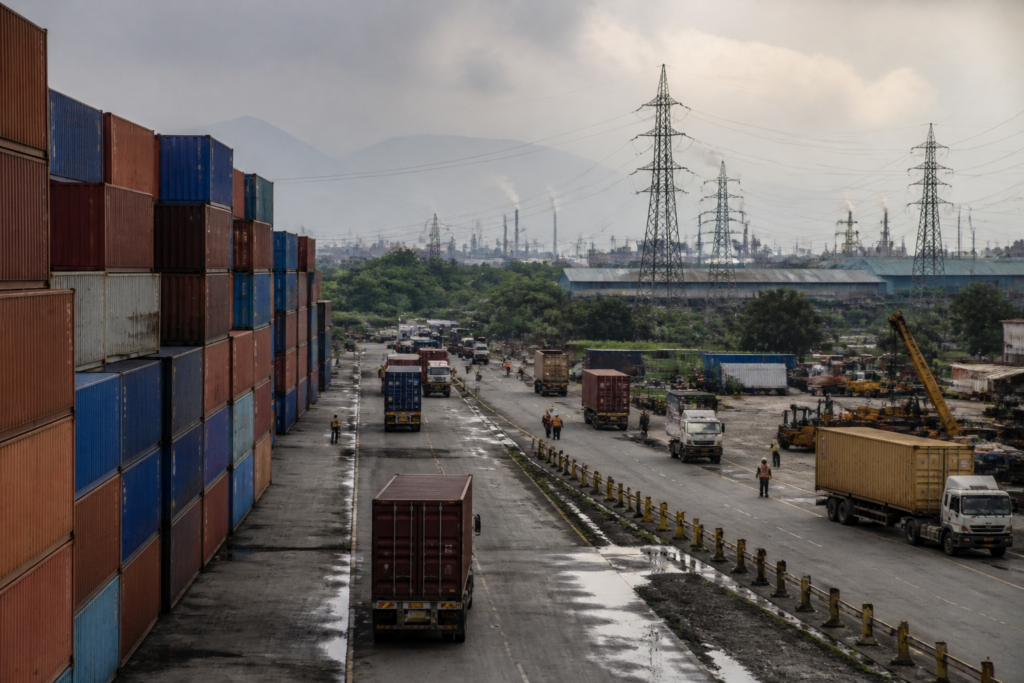
India’s attempt to rebuild economic ties with China is unfolding alongside a widening trade deficit, exposing the difficult balance between geopolitical caution and the industrial supply chains that support India’s economy. Union commerce and industry minister Piyush Goyal said India was working to develop relations with China again, but his remarks also made clear that future engagement would depend on fair terms, continuity and a stable geopolitical environment.
Speaking at the Bloomberg New Economy event, Goyal said India was open to joint ventures with any country if it received a fair deal. “We are working to develop relations with China once again, but the last word has not yet been scripted on this journey,” he said, according to PTI. The statement places economic engagement within a broader policy framework: India wants access to international capital, technology and supply networks, but does not want those relationships to become a source of strategic vulnerability.
The tension is visible in the latest trade numbers cited in the report. Bilateral trade between India and China rose 7.9% to $151.10 billion in 2025-26, from $118.39 billion in 2024-25. India’s exports to China increased 36.62%, reaching $19.47 billion from $14.25 billion. Imports, however, rose 16% to $131.62 billion. As a result, India’s trade deficit with China widened to $112.16 billion from $99.21 billion.
These figures describe more than a bilateral commercial relationship. They indicate that India’s economic growth remains linked to a manufacturing and supply ecosystem in which imports from China continue to exceed Indian exports by a substantial margin. The gap is especially important for policymakers because trade expansion alone does not show whether domestic production capacity is becoming more competitive or whether Indian businesses are becoming more dependent on imported inputs and finished goods.
For cities, this relationship is felt through the industrial systems located around them. Manufacturing clusters, logistics networks, warehouses, ports, industrial parks and technology facilities depend on predictable access to components and materials. When supply chains are disrupted, the consequences can move quickly from factories to construction schedules, consumer markets, employment and public infrastructure delivery. Goyal’s comments therefore connect foreign economic policy with the functioning of India’s built environment and urban economy.
The minister linked India’s current approach to the supply shortages experienced during the Covid-19 pandemic. He said India had struggled to obtain personal protective equipment, Covid kits and vaccines when international supply chains broke down, despite having placed orders. He argued that these difficulties contributed to the push for Atmanirbhar Bharat, or self-reliant India. Goyal also alleged that Western countries had refused to supply Pfizer and Moderna vaccines to India. Those remarks were presented as his account of the pandemic experience and were not independently examined in the supplied report.
The policy lesson Goyal drew was not that India should withdraw from global trade. Instead, he argued that partnerships with other countries would become increasingly important. “Everybody has recognised the importance of friends, and that’s going to be the most important critical element in the years to come,” he said. This suggests a strategy built around diversification: maintaining access to multiple sources of goods, technology and investment rather than relying excessively on any one relationship.
That strategy creates a difficult administrative and commercial task. Diversification requires alternative suppliers, domestic production, skilled workers, logistics capacity and investment conditions that can support scale. It also requires the state to decide where openness is beneficial and where controls are needed. Goyal’s emphasis on a “fair deal” and continuity reflects this concern, although the supplied report does not specify the terms India is seeking from China or the sectors in which joint ventures may be considered.
Investment remains a separate constraint. India has tightened its foreign direct investment policy for countries that share a land border with it, including China. The policy means that even if trade flows grow, investment and ownership relationships may remain subject to additional scrutiny. This distinction matters because trade can expand without producing the long-term technology transfer, manufacturing capacity or local employment that policymakers often associate with foreign investment.
The contrast between rising trade and tighter investment rules is central to understanding India’s current position. India appears to be seeking economic engagement without surrendering policy control over strategic sectors. That approach may protect against sudden exposure, but it can also make commercial relationships more complex for companies seeking clarity on approvals, partnerships and market access. The report does not establish how existing restrictions have affected Chinese investment or specific Indian industries, but it confirms that investment is an active concern in the bilateral relationship.
The semiconductor discussion at the same event points to one area where India is trying to build domestic capability while deepening selected international partnerships. Singapore’s deputy prime minister and minister for energy, trade and industry, Gan Kim Yong, said Singapore and India were discussing ways to strengthen India’s semiconductor industry. He said the countries were also working on training and skilling India’s workforce to support semiconductor growth.
Semiconductors illustrate why supply-chain policy cannot be separated from urban and infrastructure planning. A functioning semiconductor ecosystem requires specialised industrial facilities, reliable power, water, transport connections, technical institutions and a workforce with relevant skills. The supplied report does not identify the proposed sites, investment values, production targets or implementation timeline. It does, however, show that industrial diplomacy is being linked to the creation of capabilities that India currently wants to expand.
The India-Singapore trade pact has been in force since 2005, providing an existing institutional framework for the discussions. That framework is different from the India-China relationship, where the focus in the report is on rebuilding ties while managing concerns over trade, investment and geopolitics. Together, the two conversations show how India is attempting to construct a broader network of economic partnerships rather than depend on a single bilateral channel.
Goyal also described India-US relations as substantive and said the partnership would improve regardless of changes in political thinking in either country. He said the relationship extended beyond trade to defence, technology, critical minerals and people-to-people ties. India and the United States are negotiating a bilateral trade agreement, with discussions continuing over market access and tariffs. These negotiations are relevant to the supply-chain question because the sectors named by Goyal are closely connected to industrial capacity and strategic resilience, although the report provides no details on the outcome of the talks.
The available data establishes a clear asymmetry in India’s China trade. Exports to China grew faster in percentage terms than imports in 2025-26, but the much larger import base meant that the overall deficit still widened. This is the important distinction between faster export growth and a narrowing trade imbalance. India’s exports increased by $5.22 billion over the cited period, while imports increased by $18.02 billion. The calculation shows why stronger export growth alone has not yet reversed the structural gap.
The numbers also complicate the idea that geopolitical tensions automatically reduce economic interdependence. Despite policy concerns and tighter foreign investment rules, bilateral trade increased sharply in the period cited by the report. Commercial demand and industrial dependence can therefore continue even when strategic trust is limited. For urban India, that dependence is embedded not only in headline trade values but also in the movement of components, equipment and goods through ports, freight corridors, industrial areas and distribution centres.
What remains uncertain is how India will translate the language of self-reliance and diversification into measurable domestic capacity. The supplied material does not provide sector-wise import data, details of production-linked investments, project locations, employment numbers or a timetable for semiconductor expansion. It also does not establish whether the proposed India-Singapore cooperation will lead to operational facilities or how future India-China joint ventures would be assessed.
The immediate evidence supports a more limited conclusion. India is not choosing between complete economic separation and unrestricted engagement. It is attempting to keep trade and investment channels open while reducing exposure to supply disruptions, tightening scrutiny where it considers strategic risks significant, and building relationships with countries such as Singapore and the United States. The widening China trade deficit shows why that balancing act remains unresolved.
The next developments to monitor are the terms of any renewed India-China commercial engagement, the operation of foreign investment rules for land-border countries, progress in India-Singapore semiconductor cooperation, and the continuing India-US trade negotiations. These decisions will determine whether India’s supply-chain strategy produces greater domestic capacity or simply adds more partners to an import-dependent system.


