

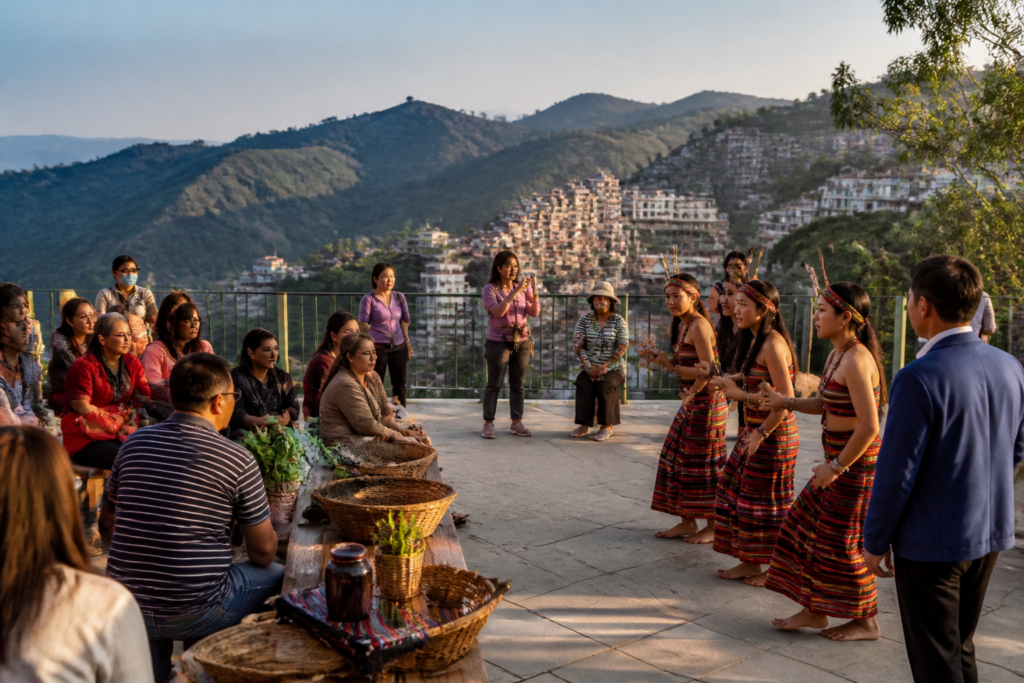
Mizoram’s tourism push has entered a new phase. The state is no longer presenting tourism only as a way to bring visitors to Aizawl and its surrounding destinations; it is attempting to build a year-round economic system around festivals, homestays, local food, cultural experiences, improved connectivity and new public infrastructure. The three-day Mizoram travel fest, which opened in Aizawl on Tuesday, has brought that ambition into focus.
Organised jointly by the state tourism department and the Union tourism ministry, the event has brought together tour operators, homestay associations, culinary professionals and other tourism stakeholders. Its agenda includes eco-tourism, community-based tourism, adventure activities, connectivity and destination promotion. The second day is scheduled to focus on investment opportunities and sustainable tourism development, with business-to-business meetings involving tour operators, accommodation providers, restaurants and other tourism service providers.
The immediate backdrop is a sharp increase in visitor numbers. Mizoram recorded more than 6.7 lakh visitors between January and August this year, a 51% increase over the corresponding period in 2025, according to the report. Tourist arrivals also rose by around 97% between 2024 and 2025. These figures indicate that demand is growing, but they do not by themselves establish whether the state has the accommodation capacity, transport systems, waste services, visitor management mechanisms and local workforce needed to sustain that growth.
That distinction matters because Mizoram’s stated objective is not simply to increase arrivals. The state aims to attract 12 lakh tourists annually by 2030 and 20 lakh by 2047. It also plans to develop 10 Culture, Adventure and Nature tourism circuits connecting 40 destinations by 2047. These targets suggest an attempt to distribute tourism beyond a few established locations and to connect cultural and natural assets with a wider network of local enterprises.
The planning challenge is therefore larger than destination promotion. A tourism circuit is an infrastructure and governance system as much as it is a marketing concept. It depends on reliable access between destinations, safe and suitable accommodation, trained service providers, food and sanitation facilities, communications, emergency response and mechanisms to protect the places being promoted. The supplied report does not provide details on the capacity or current condition of these systems, leaving implementation as the central question behind the targets.
## Connectivity changes the geography of tourism
Improved connectivity, particularly after the opening of the Bairabi-Sairang railway line in September last year, has strengthened Mizoram’s tourism prospects, the report said. The railway connection is significant because access shapes which destinations can participate in tourism and how easily visitors, supplies and workers can move through the state.
For the state government, the railway line offers more than a transport link to Aizawl. It can support a broader destination network if visitor movement is connected to onward travel, local accommodation and attractions outside the capital. Without those links, improved access may increase concentration in a small number of places rather than create the distributed tourism economy envisaged in the 2047 plan.
The report does not state how many visitors arrived by rail, nor does it provide a breakdown of tourist origins, length of stay or spending patterns. Those details will be important for assessing whether rising arrivals are translating into local income. A higher visitor count can coexist with limited community benefit if tourists spend little time in local destinations, rely on services owned outside the region or remain concentrated around a few venues.
The state’s own framing recognises this issue. Inaugurating the festival, tourism minister Lalnghinglova Hmar said tourism should generate employment and income for local communities while protecting Mizoram’s culture and natural environment. “Tourism is not simply about bringing visitors into Mizoram. It is also about ensuring that the benefits reach the people who make Mizoram special,” he said.
That statement places distribution and protection alongside growth. It also identifies the institutional test for the tourism strategy: whether investment and visitor expansion can be connected to local participation instead of being measured only through arrivals or large projects.
## Public investment is building the supply side
Nearly Rs 680 crore in tourism investment has been mobilised in Mizoram since 2023, according to the report. This includes 11 major projects sanctioned at a total cost of Rs 608.38 crore. The projects include tourist facilities and attractions worth Rs 250 crore, a Rs 127-crore PM Ekta Mall, a Rs 99.71-crore conference centre at Thingsulthliah and a Rs 34.50-crore ropeway project at Thenzawl-Buangpui.
The figures show that the state’s strategy has a substantial public infrastructure component. The investment is spread across visitor facilities, retail and cultural or commercial infrastructure, conference capacity and an attraction-oriented transport project. Together, these projects indicate an effort to create reasons for visitors to travel, stay and spend rather than treating tourism as a standalone promotional activity.
However, sanctioned investment and mobilised investment are not the same as completed and operational capacity. The report does not specify the construction status, opening dates, projected visitor capacity or operating arrangements for the individual projects. It also does not explain how these facilities will be connected to homestays, local food enterprises, tour operators and community-based tourism initiatives.
That connection will determine whether the capital programme supports the state’s stated social objective. A conference centre or a large visitor attraction may increase footfall, but the local economic impact depends on procurement, staffing, supply chains, transport services and the ability of smaller enterprises to participate. The travel fest’s inclusion of the Association of Tour Operators in Mizoram, the Indian Association of Tour Operators, Homestays of India and the Mizoram Culinary Association suggests that the government is attempting to build those commercial links, although the event’s eventual outcomes are not yet established.
The same applies to sustainability. Eco-tourism and community-based tourism were among the opening-day discussion themes, while sustainable tourism development is scheduled for the second day. These terms point to a policy direction, but the report does not set out carrying-capacity rules, waste-management standards, environmental monitoring systems or community ownership models. Those operational details will be necessary if natural and cultural assets are to remain viable as visitor numbers rise.
## Festivals are being used as a year-round tourism calendar
Mizoram is also seeking to address the seasonality of tourism by linking festivals and cultural events with natural attractions and local enterprises. The state’s upcoming calendar includes the Leitlangpui music festival in Lunglei from November 11 to 13, Aizawl’s Winter Festival from December 15 to 23 and the Hnahsin Kut, or Cosmos Festival, in Champhai, which will continue until October 16.
This approach can help create a sequence of travel opportunities rather than a single peak period. It also gives destinations outside Aizawl a role in the state’s tourism proposition. Lunglei and Champhai are not merely named as locations for events; they are part of the wider effort to construct a multi-destination network around culture, music and local identity.
Yet an events calendar can only support year-round tourism if the supporting systems operate throughout the year. Visitors need predictable transport, accommodation, food services and information, while host communities need arrangements that protect cultural practices from becoming only commercial displays. The report records the state’s stated intention to balance tourism with culture and the natural environment, but it does not provide evidence on how that balance will be administered.
The emphasis on homestays and culinary professionals is important in this context. These sectors can allow tourism spending to reach households and small businesses directly. They can also make destinations more attractive by offering experiences rooted in local communities. At the same time, their participation may require training, quality standards, digital market access and basic infrastructure, none of which are detailed in the supplied material.
## The larger urban and regional question
Mizoram’s tourism plans illustrate how transport, public investment, local enterprise and cultural policy increasingly overlap. Although the headline event is taking place in Aizawl, the proposed tourism circuits extend the question across the state. Roads and railways determine access; public facilities shape visitor capacity; municipal and local institutions manage waste and public spaces; and communities determine whether tourism creates durable livelihoods.
Aizawl’s role will be especially important because it is the state capital, the location of the travel fest and a likely gateway for visitors. The success of a distributed tourism model will partly depend on whether the capital functions as a connection point rather than the final destination for most trips. The supplied report does not provide visitor-flow data or destination-level figures, so that pattern cannot yet be assessed.
What the available evidence confirms is that Mizoram has moved from promotion alone towards a more coordinated tourism strategy. Visitor numbers have risen, rail connectivity has improved, major investments have been mobilised and the state has established targets extending to 2030 and 2047. What remains unclear is how quickly the sanctioned projects will become operational, how benefits will be measured at the community level and what safeguards will govern growth in environmentally and culturally sensitive locations.
The next phase of the strategy will therefore be judged less by the number of festivals announced than by whether the new connectivity and investment produce a functioning network of destinations, enterprises and public services. The travel fest’s business meetings and discussions on sustainable development are the immediate institutional steps. Their outcomes will show whether Mizoram’s year-round tourism ambition can move from a calendar of events to a durable regional economy.


