

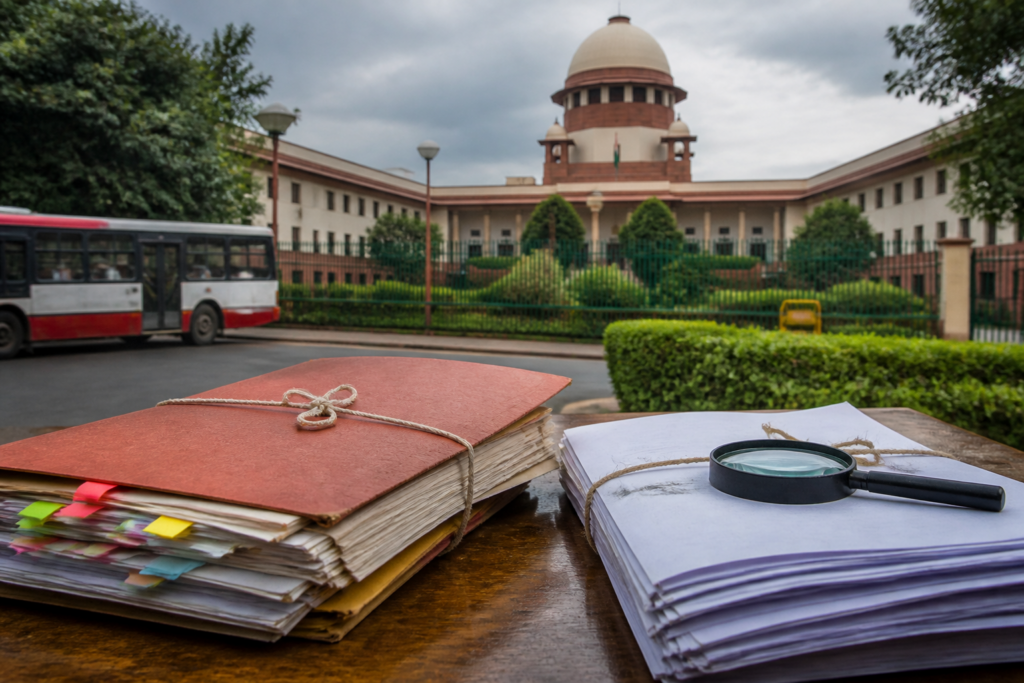
A letter from senior IPS officer Alok Kumar to Karnataka’s Chief Secretary has turned a dispute over a court-appointed investigation team into a larger question about how official records, legal submissions and institutional reputations are handled in high-stakes public-interest litigation. Kumar says statements made in the Supreme Court about his past involvement in the Karnataka phone-tapping case were factually incorrect because the Central Bureau of Investigation (CBI) investigation had been closed and the closure report accepted by a special court.
The immediate dispute concerns two Karnataka Public Service Commission recruitment cases. The Karnataka High Court had ordered a fresh investigation by a court-appointed Special Investigation Team and named Director General of Police-rank officer Kumar as its chief. The state government challenged the arrangement before the Supreme Court, arguing that the executive, rather than the court, should retain discretion over the selection of SIT members.
Senior Advocate Kapil Sibal, appearing for the Karnataka government, opposed Kumar’s appointment as SIT chief by referring to past allegations linked to the phone-tapping case. He also raised a possible conflict of interest involving another proposed SIT member, Dr Divya Gopinath, who heads the state Forensic Science Laboratory. The Supreme Court stayed the September 21 High Court order and later allowed the Karnataka government to replace members of the investigation team.
Kumar’s October 5 letter gives the episode a second institutional dimension. He asked Chief Secretary Shalini Rajneesh to intervene and ensure that the state’s affidavit before the Supreme Court did not contain what he described as unverified or incorrect allegations. He said he had been “deeply distressed” that his professional integrity had been questioned nationally and maintained that the statements made in court were contrary to official records.
The distinction between an allegation, an investigation and a judicially accepted closure report is central to the dispute. According to the report, the CBI registered an FIR after allegations surfaced in 2019 that phone calls involving politicians, bureaucrats and prominent public figures had been illegally intercepted. Kumar was Bengaluru city police commissioner at the time. He was transferred 47 days after taking charge under the government led by then chief minister B S Yediyurappa.
The CBI conducted searches and questioned Kumar during the investigation. It filed a closure report, known as a B-report, in June 2021 after concluding that the investigation could not establish that Kumar had leaked lawfully intercepted audio files to a journalist. A special court formally accepted the closure report in February 2024. That sequence is important because a closed investigation does not erase the fact that an investigation once occurred, but it does not support describing the matter as a pending CBI probe if the supplied record is accurate.
The institutional problem exposed here is not limited to one officer’s reputation. Courts depend on parties and their legal representatives to present a reliable account of earlier proceedings, official records and the status of investigations. Governments, in turn, depend on departments and legal teams to maintain an accurate chain of information before submissions are made. When a past case is used to question the suitability of an officer for a sensitive assignment, the precision of that information becomes part of procedural fairness.
The KPSC recruitment cases make that question especially consequential. Recruitment investigations involve public confidence in examinations, appointments and the state’s ability to protect merit-based selection. The High Court’s decision to specify the officers for the SIT indicates that the composition of the team was itself considered important to the credibility of the inquiry. The state’s objection, meanwhile, reflects a competing institutional principle: that the government should have operational control over its investigative personnel.
The Supreme Court’s interim intervention did not resolve that broader question in the supplied material. It stayed the High Court’s September 21 order and subsequently allowed the state to replace SIT members. The dispute therefore illustrates the tension between judicial efforts to secure confidence in an investigation and the executive’s claim to administrative discretion. The credibility of an SIT depends not only on its formal mandate but also on how its members are selected and whether their appointment is seen as independent and free from conflicts.
The episode also shows why conflict-of-interest concerns must be separated from general allegations. Sibal questioned Kumar’s appointment by citing the phone-tapping matter and raised a separate concern about Dr Gopinath’s role as head of the state Forensic Science Laboratory. These are different issues. One relates to the status and interpretation of a past investigation involving a proposed SIT chief. The other concerns whether an institutional position could affect the perceived independence of a proposed team member. Treating both as broad questions about credibility can obscure the specific evidence required for each.
Kumar’s record also includes a separate departmental track. A departmental inquiry initiated by the state government was closed in May 2023 after the government led by then chief minister Basavaraj Bommai dropped all charges against him. In May 2025, however, the state issued a fresh show-cause notice and ordered a new inquiry. Kumar challenged that action before the Central Administrative Tribunal, arguing through his counsel that the proceedings were initiated with mala fide intent to affect his prospective promotion. The CAT stayed the government’s action.
The state later filed a writ petition challenging the CAT order. The Karnataka High Court declined to grant a stay, and the matter remains pending, according to the report. This separate litigation is relevant because it means Kumar’s official record contains more than one legal and administrative proceeding. It also makes careful description more important: the closure of the CBI phone-tapping investigation, the closure of the earlier departmental inquiry and the continuing dispute over the later show-cause notice are distinct developments with different procedural statuses.
Kumar was promoted to DGP rank in December 2025 and currently heads Prisons and Correctional Services. The promotion does not, by itself, determine the merits of the pending CAT-related dispute or settle the disagreement over his suitability to lead the KPSC SIT. It does, however, show how judicial, departmental and administrative processes can overlap over several years while an officer continues to hold senior public responsibilities.
For Karnataka’s governance system, the case raises a practical accountability question: who verifies the status of sensitive allegations before they are placed before a constitutional court? The supplied material does not establish whether the statements cited by Kumar resulted from an error in the state’s briefing, an incomplete record or a different interpretation of the proceedings. Kumar says he was incorrectly briefed and has asked the Chief Secretary to correct the record. The government’s final response to that request is not provided.
The Supreme Court proceedings will determine the immediate legal position of the KPSC investigation team. The pending High Court matter concerning the CAT order will determine whether the later departmental action against Kumar can proceed. Together, these developments deserve to be tracked separately rather than collapsed into a single narrative about the officer. The evidence currently establishes a dispute over the accuracy of courtroom submissions, a closed CBI investigation, a formally accepted closure report, a stayed recruitment-investigation arrangement and a separate pending service matter. It does not establish that every allegation connected to Kumar was false, nor that any pending proceeding has been finally decided.
The larger lesson is institutional rather than personal. In cases involving police leadership, recruitment integrity and court-appointed investigations, the credibility of the process depends on accurate records, clearly defined conflicts and transparent procedural status. The next significant developments will be the state’s response to Kumar’s request, further Supreme Court proceedings on the KPSC SIT and the Karnataka High Court’s consideration of the challenge to the CAT order.


