

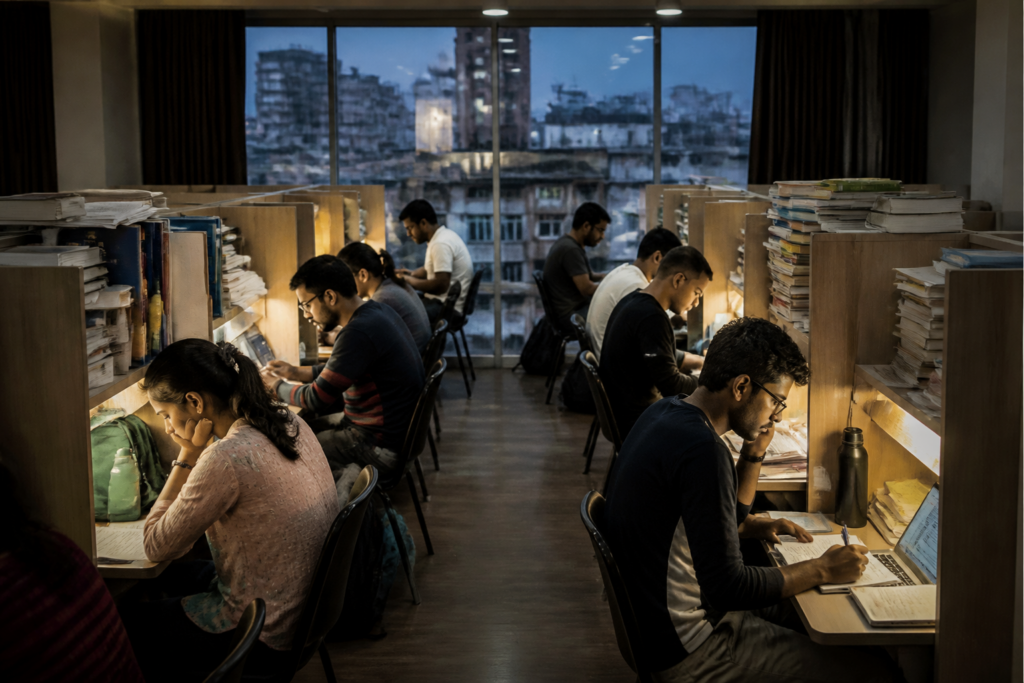
Pune’s MPSC aspirants are paying a rising urban cost for an examination system they say has become unpredictable. In study spaces across Narayan Peth and Karve Nagar, candidates are not only preparing for changing exam patterns but also financing prolonged stays in the city, managing family pressure and waiting for recruitment cycles whose timelines can stretch across several years.
The immediate backdrop is the recent protest by aspirants demanding the resignation of the Maharashtra Public Service Commission chairperson over allegations of paper leaks. The protests ended after the government decided to set up an investigative committee. But the concerns described by students extend beyond the allegations themselves. They point to a system in which uncertainty about examinations becomes a financial and social burden, particularly for candidates from rural and modest-income backgrounds.
Pune’s role as a preparation centre makes that burden visible. Students from Chhatrapati Sambhajinagar, Kolhapur and villages near Wagholi come to the city because they need access to study spaces, accommodation and a peer environment. The city’s ‘libraries’, as local study rooms are known, have become part of the examination infrastructure. Yet every additional month spent in Pune brings another round of hostel, paying guest, mess, transport and study-space expenses.
For candidates who can rely on family support, the cost is difficult. For those who cannot, preparation becomes a cycle of work and study. Pranita Kapse, 24, who has prepared for civil services for two to three years and made two attempts, cleared the Sarathi scholarship examination to support her education. She has also worked as a library coordinator, at a drapery shop, in a business process outsourcing company and as an English tutor. Her experience shows how preparation time is not uniformly available to aspirants. The ability to study full-time depends partly on whether a candidate can absorb the cost of remaining outside the family home.
That cost is magnified when the examination calendar changes or recruitment is delayed. Ayodhya Umap, 22, who moved from Chhatrapati Sambhajinagar to prepare for the MPSC services, said that hostel, paying guest and mess expenses continue to rise. When examinations are held on schedule, she said, her finances remain more manageable. Delays have the opposite effect.
The uncertainty also changes how candidates assess the value of each year spent preparing. Umap described the fear that an examination may not be transparent or could be affected by a leak. If a paper is cancelled or a recruitment cycle is disrupted, the loss is not limited to the examination fee. Candidates may have to repeat months of preparation while continuing to pay for accommodation and food. Those who work alongside their studies may also have to postpone or reduce employment opportunities.
This is the central institutional issue exposed by the experiences in Pune: an examination delay is not an administrative event with a cost confined to the commission. It transfers the cost to candidates and their families. The longer the recruitment cycle, the more the system relies on households to finance uncertainty. That burden is uneven because candidates arrive with different levels of family income, access to housing and ability to take temporary work.
The source report also shows how changes in the examination pattern add to that uncertainty. Kapse said the movement between objective and descriptive formats has the heaviest effect on aspirants from modest and rural backgrounds. A changing pattern requires candidates to alter their study material, preparation methods and sometimes their coaching arrangements. It can also make preparation less portable for students who have already spent years building a specific set of skills.
The problem is compounded by the lack of quality Marathi-medium study material described by the students. Many aspirants translate English and Hindi sources themselves. This is not merely a question of convenience. It adds unpaid labour to preparation and places candidates who depend on Marathi-medium resources at a disadvantage in time and access. Students must spend hours converting material before they can begin using it for revision, answer writing or conceptual study.
The language issue is especially important because the recruitment system draws candidates from across Maharashtra, not only from Pune’s established coaching and education networks. When material is easier to find in English or Hindi, candidates with stronger language access can move faster through preparation. Those who need Marathi resources may have to depend on informal translations or create their own notes. The report does not establish the scale of this gap, but the accounts of the students show how it becomes part of the everyday cost of appearing for a state examination.
Women candidates face an additional layer of pressure. Umap said families push daughters to clear the examination quickly because of expectations around age and marriage. Preeti Nagawade, 24, who comes from Wade Bolhai near Wagholi and studied architecture, said that candidates carry the expectation that they should secure a post by their late twenties. Such pressure compresses the time available for preparation and makes recruitment delays more consequential for women.
Nagawade’s account also reflects the social cost of migration for education. She depends on her family, who run a hotel and grocery store, for expenses in Pune and described living away from home as a process of becoming detached from familiar emotional support. The physical move to the city may provide access to study infrastructure, but it also separates candidates from the family and community networks that help them manage stress and daily needs.
The length of the recruitment cycle is another part of the problem. Atharva Pradhan, a 24-year-old agriculture graduate from the College of Agriculture, Pune, recalled a batch that took the preliminary examination in 2023, the mains in November 2024, interviews in early 2025 and joined training only in May. According to his account, the candidates spent almost three years in the examination cycle.
That timeline demonstrates why the commission’s schedule matters beyond the date of a test. A recruitment process includes several stages, and delay at any stage extends the period during which candidates must remain available, continue preparing and defer other decisions. For a young person living in Pune, the examination cycle is therefore also a housing cycle, a work cycle and a family negotiation.
The commission’s credibility is consequently tied to the reliability of the city-based ecosystem around it. Study rooms, hostels, paying guest accommodation, messes and informal tutoring arrangements all operate around the expectation that examinations will follow a reasonably clear schedule. When that expectation weakens, candidates continue paying for the ecosystem without receiving the certainty that justified the expense.
The government’s decision to establish an investigative committee following the protests addresses the immediate allegations around paper leaks, as described in the report. It does not, by itself, resolve the other concerns raised by aspirants: changing examination patterns, delays between stages, limited Marathi-medium study material and the lack of clarity about recruitment timelines. These are connected because each one affects how much time and money candidates must commit before they know whether the process will proceed.
The students’ comparison with the Union Public Service Commission also points to a demand for accountability, though the supplied accounts do not provide a detailed comparison of the two systems. What they do establish is that MPSC aspirants want greater confidence that examination rules, schedules and recruitment stages will be dependable. Their concern is not simply whether a particular paper is conducted. It is whether the institution can provide a stable path from preparation to appointment.
Pune’s examination economy makes this institutional question a built-environment and urban livelihood issue. Aspirants live in rented rooms, use commercial study spaces and depend on local food and transport services while preparing for public employment. They are part of the city’s temporary population, but their needs are shaped by long stays rather than short visits. A delayed recruitment process therefore has direct consequences for how they occupy and pay for the city.
The evidence in the accounts is qualitative rather than a citywide cost survey, and it does not establish how many candidates are affected by each problem. It does, however, show a consistent pattern across students from different places and backgrounds: the longer and less predictable the process, the more private resources candidates must spend to remain in it.
What remains to be seen is whether the investigative committee’s work will restore confidence around examination integrity and whether the commission can provide greater clarity on recruitment schedules and examination patterns. For Pune’s aspirants, the issue is not only the result of one paper. It is whether a public recruitment system can prevent years of preparation, accommodation costs and personal sacrifice from being extended by institutional uncertainty.


